
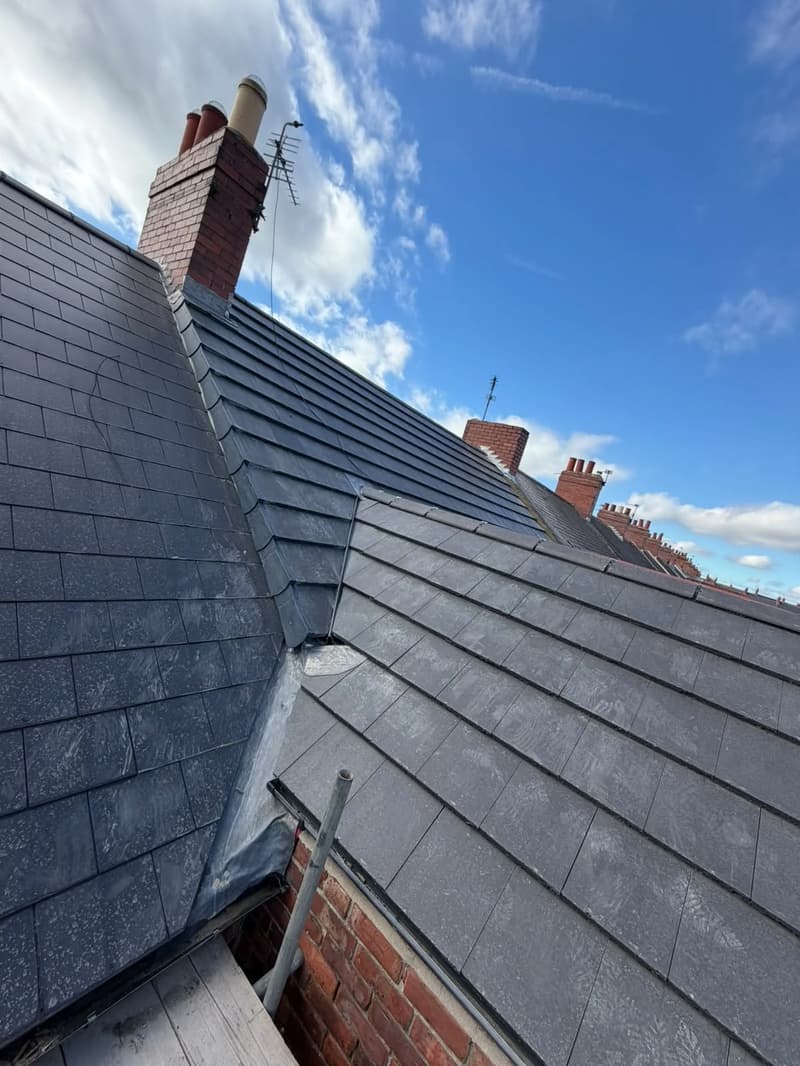
Roof work by McCluskey Roofing
Terraced streets and shared stacks
Heaton and Jesmond include terraces with prominent chimney stacks, while Fenham also has streets of homes with roof-level masonry to consider. A stack may serve neighbouring properties, even when only one household has noticed a problem. Ownership, roof access and the relationship between the adjoining coverings need discussing before the work is planned.
Look from the street for missing joints, damaged bricks or loose pieces, but do not climb to check the top. Photographing the whole stack from a safe distance can help explain which part is affected. If material has fallen into a yard or pavement, keep clear of the area beneath it. Instability is a safety concern, not a reason to attempt a quick household repair.
Mortar failure is not the same as flashing failure
Repointing addresses deteriorated joints in the masonry. The mortar needs to suit the existing construction, with sound preparation rather than a thin surface coating over loose material. Damaged bricks or wider movement may call for a different scope, so the visible loss of mortar should be assessed in context.
Flashing forms the weathering junction between the stack and roof covering. An open chase, split lead or poorly arranged overlap can let rain into the roof even where the masonry joints are sound. Renewing mortar above will not close a defective flashing below. Ask the proposal to identify masonry and leadwork separately so you understand which defect the suggested repair is intended to resolve.
Reading damp around a Newcastle chimney breast
The height and pattern of staining can be useful evidence, especially when it changes after wind-driven rain. Record whether damp appears near the ceiling, lower down the breast or in an accessible loft area. Water can travel through the roof assembly, so the visible stain is not necessarily directly beneath the point where rain enters.
A disused or poorly ventilated flue can also have moisture issues that are not solved by exterior patching. Explain the fireplace history and any recent changes to ventilation or appliances. Do not assume that covering a fireplace makes the whole flue redundant. Where an active appliance is involved, appropriate specialist advice about its flue remains necessary before the chimney-top arrangement is changed.
Pots, the top surface and exposed masonry
The mortar weathering around chimney pots is distinct from the joints down the sides of the stack. Cracks there may allow moisture into the upper masonry, while a loose pot presents a different concern again. Each part should be examined with suitable access rather than diagnosed from a close-up taken at ground level.
A cowl or cap must be appropriate to the flue's function and ventilation needs. It is not a universal cure for a wet chimney breast. Similarly, rebuilding damaged upper masonry is different from replacing weathered pointing. Our related chimney pages explain these separate elements; the assessment establishes whether any of them is relevant to the particular Newcastle stack.
Planning access and a Newcastle chimney quote
Mention the stack's position, the number of storeys and any conservatory or extension directly beneath it. Rear lanes, narrow passages and shared yards can influence where safe access is possible. If a roof replacement is being considered too, bring both enquiries into the conversation so the junction and access needs can be understood together.
For a free quote, provide your postcode and explain the symptoms without guessing the repair in advance. McCluskey Roofing can discuss the next assessment for the relevant chimney work. The Newcastle area hub also links to roof repairs and flat roofing if your leak appears away from the stack. Separating these possibilities is more useful than assuming every stain in a terraced home begins at its chimney.