
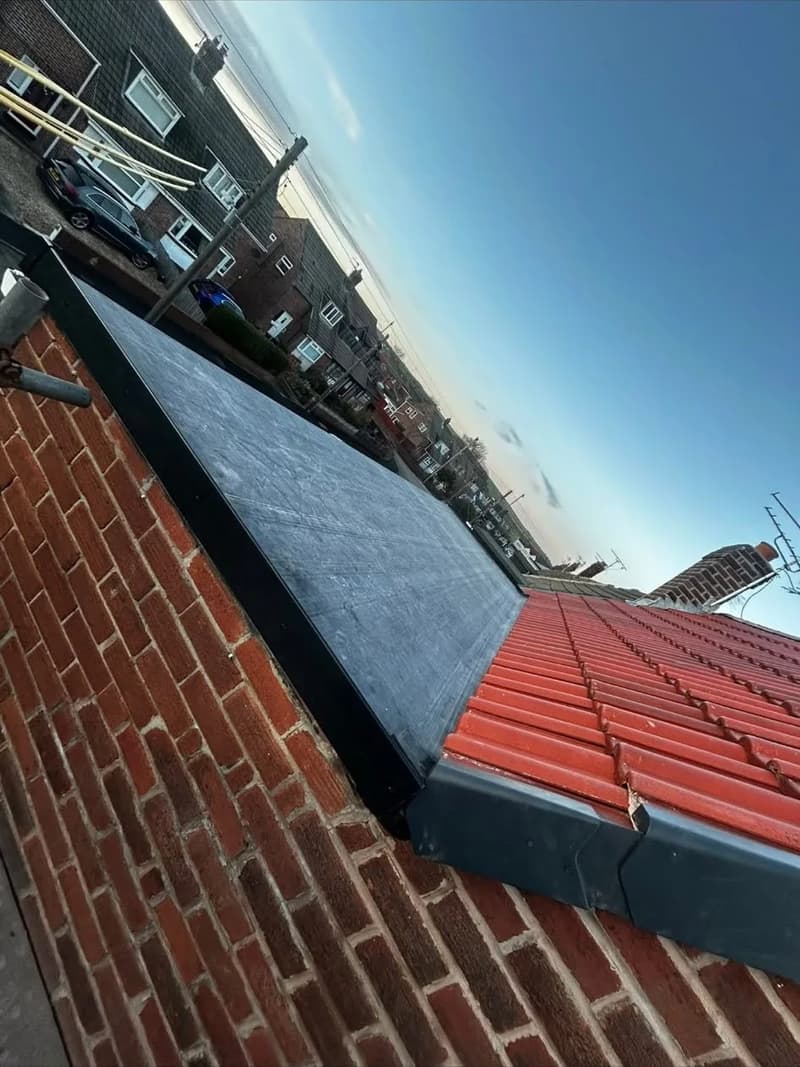
Roof work by McCluskey Roofing
How a fibreglass roof is laid
A GRP roof starts with a firm, dry deck, usually sheets of specialist roofing board fixed tightly together. Preformed trims go round the edges, then resin is rolled into glass matting so it bonds to the board and the trims in one layer.
Once that laminate has cured, a topcoat is applied to protect it from sunlight and give the finished colour. Because everything relies on chemical curing, the weather on the day matters. Rain, frost or damp boards can spoil the bond, so timing is planned around the forecast.
Where GRP roofing works well
The finished surface is rigid and hard-wearing, which is why GRP is often chosen for balconies, walkways and small roofs that people step onto. It also forms neat shapes around corners and edges because the trims are bonded into the laminate.
On small dormer tops and porch roofs, a single seamless skin with crisp edges can look tidy from the street.
Where it is less suitable
Fibreglass does not like movement. On a roof with a springy deck or one that flexes as timber dries out, the laminate can crack along joints. Large roofs with lots of movement are often better served by a flexible membrane.
Repairs are possible but need careful preparation so the new resin bonds to the old surface, and colour matching an aged topcoat is not always exact.
GRP vs EPDM
EPDM is a single sheet of synthetic rubber, bonded down and finished with trims. It stays flexible in cold weather and copes with small amounts of movement. GRP is rigid, very tough on the surface and can be walked on more freely.
For a garage or extension roof that is rarely walked on, rubber is usually the straightforward choice. For a balcony or a roof used as a path to a door, fibreglass deserves a serious look. Our EPDM page explains the rubber option in more depth.
How long a GRP roof should last
Lifespan depends on the quality of the deck, the laminate thickness, the topcoat and how much foot traffic the roof gets. Our flat roof lifespan guide looks at what helps every type of covering last longer.
What happens to the deck
GRP is only as good as the board beneath it. On most re-covers the old covering and decking are stripped, the joists are checked and new boards are laid with tight joints. Joints between boards are taped before laminating so any small movement is spread rather than concentrated in a crack.
If the joists are uneven, firring pieces are added so the finished roof falls properly towards the outlet.
Edges, upstands and finishes
Trims at the edges and drip into the gutter are bonded into the laminate. Where the roof meets a wall, the GRP is turned up the brickwork and covered with a flashing.
Topcoats come in a range of colours and can include a grit finish for grip, which is worth considering on balconies and paths. The colour you pick also affects how warm the surface gets in sun.
Planning the work
Because resin cures best in dry, mild conditions, the timing is planned around the forecast. A small roof can often be stripped, boarded and laminated in a short spell of settled weather, with the topcoat following once the laminate has hardened.
Getting a fibreglass roof quote
Let us know the rough size of the roof, how it is used and what is on it now. We will look at the deck and the details, talk through GRP and the alternatives, and give you a free quote.