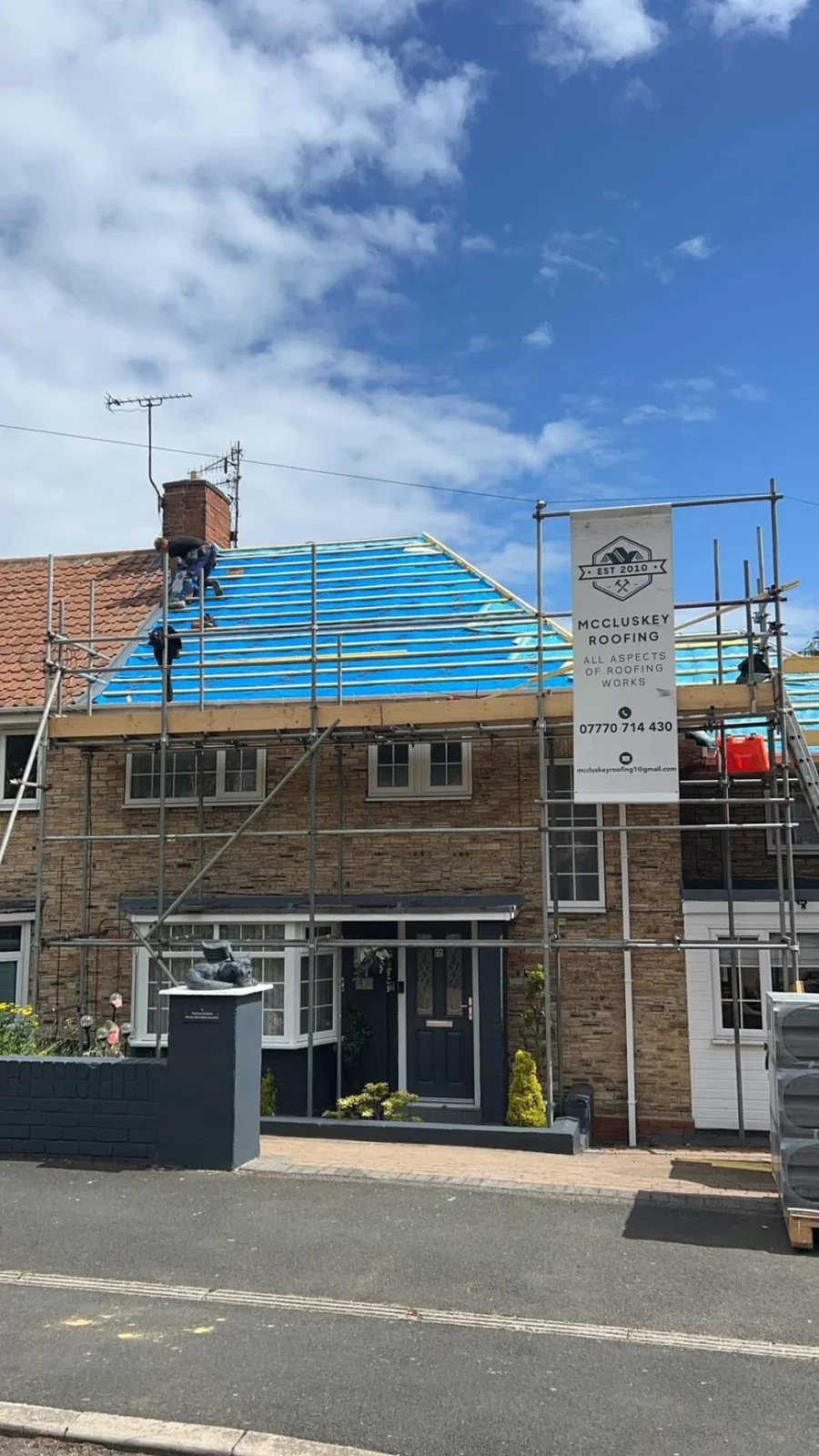
Roof work by McCluskey Roofing
Describe the same problem to each contractor
Begin with the postcode, roof type and what you have noticed. Explain recurring leaks and previous repairs if known. Provide safe photographs rather than attempting access yourself. Offering consistent information makes it easier to compare how different contractors assess the same issue, rather than accidentally asking one about a small patch and another about a replacement.
An initial telephone discussion is not necessarily the complete diagnosis. Ask what needs inspecting and which details cannot be established from the ground. A willingness to distinguish known facts from assumptions is useful. Be cautious about treating certainty from a single distant photograph as a substitute for understanding the roof and its hidden layers.
Get the proposed scope in writing
A written quote should identify the part of the roof being treated and the work intended there. Re-bedding ridge tiles, changing flashing and replacing the whole covering are very different scopes. Ask about preparation and reinstatement as well as the final appearance. Clear exclusions matter because they show what is not included in the proposal.
If two descriptions differ, ask why before assuming they refer to equivalent work. One may retain support layers that another proposes renewing, or allow for a different access arrangement. The point is not to demand the longest document but to understand the construction decisions and responsibilities well enough to make a meaningful comparison.
Materials and hidden findings need discussion
Identify the intended covering, relevant fixings and the weathering details involved. Exact products may depend on suitability and availability, particularly when matching an existing roof. Ask what happens if lifting reveals deteriorated battens, underlay or support. Those findings should be discussed rather than treated as an unlimited assumption in either direction.
A quote cannot honestly establish every concealed condition without investigation. It can explain the basis on which the scope has been prepared and how changes would be agreed. Ask whether photographs or a written explanation of findings will be available where relevant, without assuming the contractor provides a particular reporting service unless that is confirmed.
Understand scaffold and access arrangements
Safe access is part of roofing work, not an optional decorative addition. Ask how the affected area will be reached, whether scaffold is included and who is responsible for arranging it. A narrow side passage, pavement frontage or glazed extension below the main roof can influence the practical method and the space needed around the building.
Also discuss deliveries, storage and any neighbour-related permissions that may be necessary. Equipment may affect access to doors or shared areas while it is in place. Clarifying those details before work starts is more useful than discovering a mismatch when materials arrive. The right arrangement depends on the job and site, rather than a universal method for all houses.
Waste and the household during the job
Stripping a roof creates old covering, supporting material and packaging to manage. Ask how waste will be collected and removed and whether that is included. Establish what access the household needs to retain and which areas must remain clear. These practical matters belong in the planning conversation alongside the roofing specification.
Weather can affect when a roof can be opened and how the sequence proceeds. Discuss what is intended without expecting an unconditional completion promise irrespective of conditions. If there are particular household constraints, raise them early. An understandable plan makes the job easier to follow; it does not remove the need to respond sensibly to the actual building and weather.
See relevant work and check public information
Photographs can show covering choices, preparation and finishing details. Ask to see examples relevant to the type of work proposed, while respecting customer privacy. A photograph is not a guarantee of an identical outcome on another structure. Pitch, support and access can differ even where two completed roofs look similar from the street.
Check public business and trade profiles yourself, including the company name and contact details. McCluskey Roofing links to Checkatrade and MyBuilder without reproducing ratings or review claims on this site. Those links let you inspect the public information in its own context. Consider it alongside the scope and direct conversation rather than relying on one badge or statement.
Check that the answers address your question
A general description of roofing work may sound reassuring without explaining the defect on your home. Ask the contractor to connect the proposed action to what was observed. If a valley needs renewal, for instance, understand whether the lining, surrounding covering or support is the concern.
It is reasonable to ask for clarification in ordinary language. A useful answer distinguishes facts from assumptions and states what would need further investigation. This helps you compare the reasoning behind the scopes, rather than selecting a proposal because it contains the most technical terms or the strongest-sounding promise.
Know who to contact and how changes are handled
Confirm the business identity and a usable contact route before agreeing work. Ask how questions will be handled during the job and how any change to the scope will be discussed. Keep the written proposal so both sides have a common reference. You should be able to explain in ordinary language what work is being undertaken and why.
For McCluskey Roofing, enquiries can be made by telephone or the website form. We are based in Wallsend and work Monday to Friday, 8am to 5pm. If you would like to discuss your roof and the practical scope of work, call 07770 714430 for a free quote.