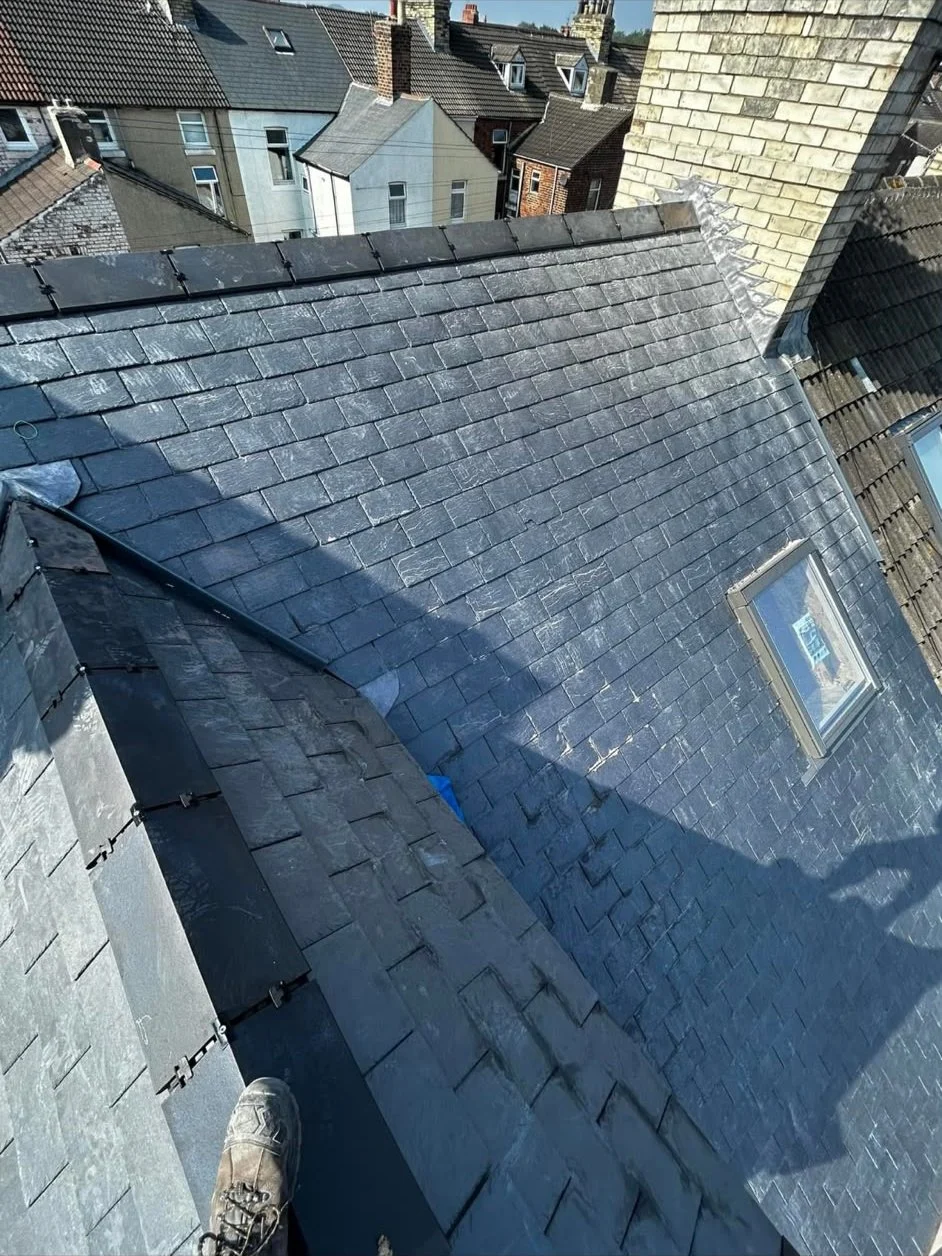
Roof work by McCluskey Roofing
Start with safety on the ground
Do not approach a hanging tile or stand beneath material that appears unstable. Keep others away if this can be done without placing yourself at risk. Indoors, avoid a visibly sagging ceiling and do not touch electrical fittings affected by water. An immediate danger to people requires the appropriate emergency service, not an attempt to inspect the roof yourself.
Observations from the ground or a safe interior position can help explain the problem. Note the roof section, when the damage became apparent and whether water is entering. There is no need to climb a ladder for a closer photograph. Strong wind, wet coverings and displaced pieces can make even apparently straightforward access hazardous.
Missing slates and disturbed tiles
Wind can act differently across a roof, particularly at edges and changes in shape. A missing covering piece may leave the layers below exposed, while adjacent pieces remain in position but have damaged or loosened fixings. The inspection should therefore consider the surrounding courses instead of replacing the obvious gap without looking further.
Underlay is not a substitute for the finished roof covering. Its condition and exposure also matter after a tile or slate has gone. Where a repair is suitable, replacement pieces need an appropriate match in shape and fixing arrangement. Availability and the integrity of nearby material can influence how the damaged area is reinstated.
Ridges, hips and verges after wind
High points and exposed edges deserve checking alongside the main slopes. Mortar may have detached from bedding or a mechanically fixed component may have moved. A ridge tile that remains on the roof is not necessarily secure, and fallen fragments do not always reveal the full length of the affected run.
The repair depends on whether damage is local or part of a wider weak arrangement. It may involve a limited re-bedding repair, renewal of components or discussion of a more suitable compatible system. Assessing these possibilities is different from assuming every wind-damaged roof needs a complete replacement or every mortared ridge should become dry-fix.
Flashing can be affected without an obvious hole
A lifted lead edge beside a chimney or wall may admit wind-driven rain even when the slates look largely undisturbed. Valleys and rooflight junctions also need consideration where the pattern of internal damp suggests an entry route nearby. Water can travel through the structure before showing itself inside the building.
Simply pressing visible lead down or applying a surface bead may leave a damaged lap or hidden component unaddressed. The investigation should identify how the detail was formed and which parts have moved. Suitable repairs restore the weathering sequence rather than treating only the point that is easiest to see from the ground.
Making safe and temporary protection
Whether loose material can be removed or temporary weather protection arranged depends on access, weather and the condition of the building. These steps require professional assessment; a roof that remains exposed during continuing wind may not be safe to approach. We cannot promise immediate attendance or that temporary measures will be possible in every situation.
Temporary protection, where appropriate, is not the permanent specification. It provides a different function from properly reinstated covering and flashing. The next discussion should explain what further assessment or materials are needed, and what the proposed repair includes. Restrictions imposed by the weather can affect sequencing and should remain part of that conversation.
Insurance is a separate homeowner decision
Buildings policies differ in their definitions, exclusions and requirements. Some distinguish a sudden event from deterioration or maintenance issues. Read your own policy and contact the insurer for instructions about evidence and authorisation. This website does not determine cover, promise a successful claim or state that McCluskey Roofing manages insurance on your behalf.
Keep safe photographs and a record of when you first noticed the problem if they are available. Ask the insurer what documents it requires before assuming a particular report or quotation will be accepted. Roofing decisions still need to address the actual condition of the roof, irrespective of how any insurance question is resolved.
Do not turn observations into a roof-access task
The safest enquiry may contain only a postcode and a description. Photographs are helpful when already available from a secure position, but are not a requirement to climb up, move debris or enter an unsafe loft. Keep people clear while the next step is discussed.
Describe the damage when requesting a quote
Give us the postcode, the affected part of the building and a clear account of what happened. Mention restricted access, adjoining properties and a glazed extension beneath the damaged slope. These details help the initial discussion focus on both the defect and the practical conditions for reaching it.
Call 07770 714430 during Monday to Friday, 8am to 5pm, or send the enquiry form. Quotes are free. The subsequent scope depends on the assessment; neither a single missing tile nor a photograph alone establishes whether isolated repair or broader renewal is needed.