Roof work by McCluskey Roofing
Repair or replace: when replacement is the sensible spend
If a flat roof has one split or a lifted edge and the rest is sound, a repair is usually the right call. Replacement becomes the better spend when problems are spread across the roof, the same areas keep failing, or the deck underneath has gone soft.
A rule of thumb is to look at what you have spent on the roof recently and what it is still costing you in damage inside. If repairs are becoming a yearly event, a planned replacement can work out better than continued patching. Our flat roof repairs page explains what can be repaired and when.
The main cost drivers
Roof area is the obvious starting point, but it is only one part. A simple rectangle is quicker to strip and cover than a roof with corners, steps, rooflights or a change in level.
Access and space matter more than people expect. A garage roof that can be reached from the drive is easier than an extension tucked behind the house with no side access. If there is nowhere for a skip, waste may need to be bagged and carried out, which takes longer.
Stripping off the old covering is labour in its own right, and some roofs have several old layers on them. The decking underneath is the big unknown. Sound boards can be kept, while rotten or swollen ones have to be replaced, and the joists checked. If the roof is over a heated room, adding or upgrading insulation can be part of the job and may be needed to meet current requirements.
EPDM or felt and what it means for the job
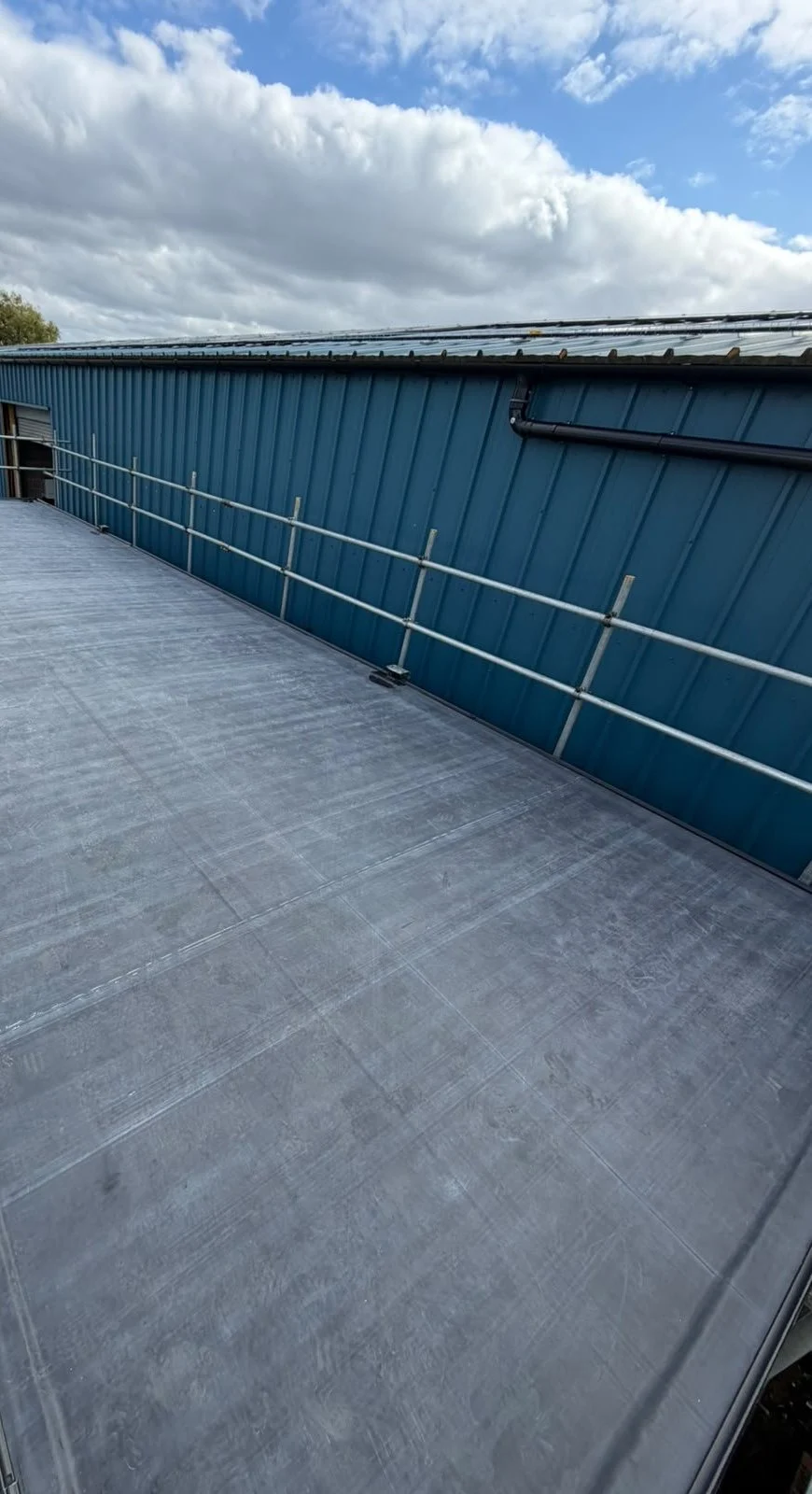
The covering you choose affects the price, but less than you might think compared with the work beneath. EPDM rubber is usually laid as a large single sheet with bonded seams and fitted trims. Felt systems are built up in layers with heat or adhesive.
We install EPDM rubber roofs, and for many homes it is the covering we recommend. If you want a detailed comparison of the materials themselves, rather than the cost of the job, our EPDM vs felt guide covers that.
Upstands, trims, outlets and edge details
Every flat roof has edges, and that is where much of the detailed work is. Where the roof meets a wall, the covering turns up as an upstand and needs a flashing over it. Free edges need trims. Water has to leave through an outlet or into a gutter, and those outlets need forming properly.
A roof with several walls around it, a rooflight in the middle and two outlets has a lot more detailing than one with three open edges and a gutter. That is often why a small roof can cost more to replace than its size suggests.
Garages, extensions and dormers compared
Detached garages tend to be the most straightforward: open edges, easy access and no heated room underneath. Extensions over kitchens or living rooms bring insulation and internal protection into the picture, and usually a wall junction with the house.
Dormer flat roofs are small but sit high up, need safe access and meet slates or tiles on several sides. Their cost reflects access and detailing more than area. Our garage roofs page explains the typical stages of a garage job.
Comparing flat roof quotes
When you have more than one quote, check that they are for the same scope. Does each include stripping the old covering, or is one an overlay? Does each allow for replacing damaged decking, and if so, how much? Are trims, upstands, outlets and gutters included, and is waste removal part of the price?
A quote that looks lower may simply leave out work that will still need doing. Ask each roofer what system they propose, how the edges and wall junctions will be detailed and what happens if the deck turns out to be worse than expected. The clearer the scope, the easier it is to choose with confidence.
Think too about how long you plan to stay in the property and how the space below is used. A garage used for storage and an extension over your kitchen do not carry the same risk if the roof fails again.
What our survey checks and how quotes are written
When we survey a flat roof, we look at the covering, the edges and outlets, the falls, the wall junctions and, where we can, the deck from underneath. We ask about leaks and how the space below is used.
Our written quote then sets out the strip-off, any decking we expect to replace, the new covering, the trims and drainage, waste removal and clearing up. Where something cannot be confirmed until the old roof is off, we say so and explain how it would be handled. Quotes are free, with no pressure to go ahead.