
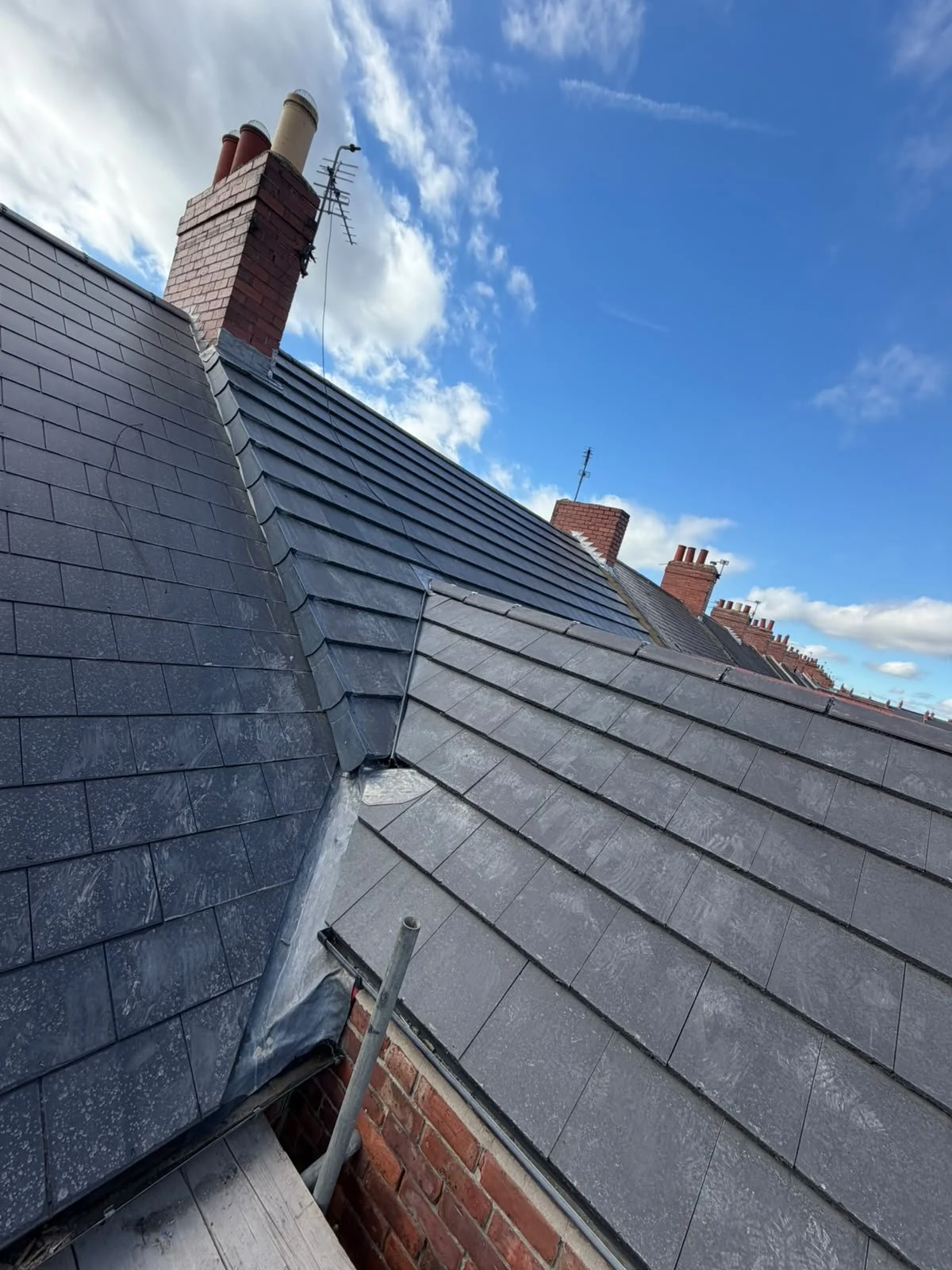
Roof work by McCluskey Roofing
Chimneys have more than one weathering detail
A chimney interrupts the roof slope on every side. The front apron directs water onto the covering below, while side flashings and, where appropriate, separate soakers protect the stepped junction. Behind the stack, the roof needs a detail that handles water arriving from further up the slope. Repairing just the most visible strip of lead may leave another route unaddressed.
Loose pointing can allow lead to withdraw from a masonry joint. A split sheet, inadequate lap or poorly supported rear detail may cause similar interior symptoms. The assessment needs to distinguish these defects. Repointing the chimney alone does not necessarily repair the flashing, and changing the flashing cannot restore defective brickwork around it.
Where a pitched roof meets a wall
An abutment occurs where a roof ends against vertical brickwork, including the side of a house or an extension wall. Rain travelling down the wall must be directed over the covering rather than behind it. The arrangement depends on the roof material and whether the junction follows the slope or runs horizontally across the top.
Visible step flashing may cover individual soakers tucked between courses below. On other coverings the appropriate detail differs. A repair should follow the system that suits the actual roof, with adequate upstand and overlap. Repeated surface patches can obscure what is underneath, so lifting a limited area may be necessary to understand how the parts connect.
Valleys collect water from adjoining slopes
A valley has a different job from a chimney apron: it receives runoff from two roof faces and carries it down a concentrated channel. Its lining must be properly supported, unobstructed and detailed to accommodate movement. Cracks, damaged laps or covering pieces extending too far into the channel can interfere with that function.
Lead is not the only possible valley material, and a photograph of a lead valley does not mean every property needs the same construction. The existing arrangement, pitch and surrounding covering inform a repair. Debris or a local break may call for limited attention, whereas a poorly formed or widely split lining can require more substantial renewal.
Hidden soakers and the visible cover flashing
Soakers are small weathering pieces integrated with courses of the roof covering at suitable side junctions. They are largely concealed once the roof is finished. Their purpose is to collect water near the wall and return it onto the covering. The cover flashing protects the upper edge, rather than substituting for the entire underlying arrangement.
A gap in the visible flashing can be important, but the absence or failure of hidden pieces may matter just as much. When water appears beside a chimney breast or extension wall, the investigation should consider the sequence of layers. Identifying a missing component is more useful than repeatedly treating the surface where the leak seems to originate.
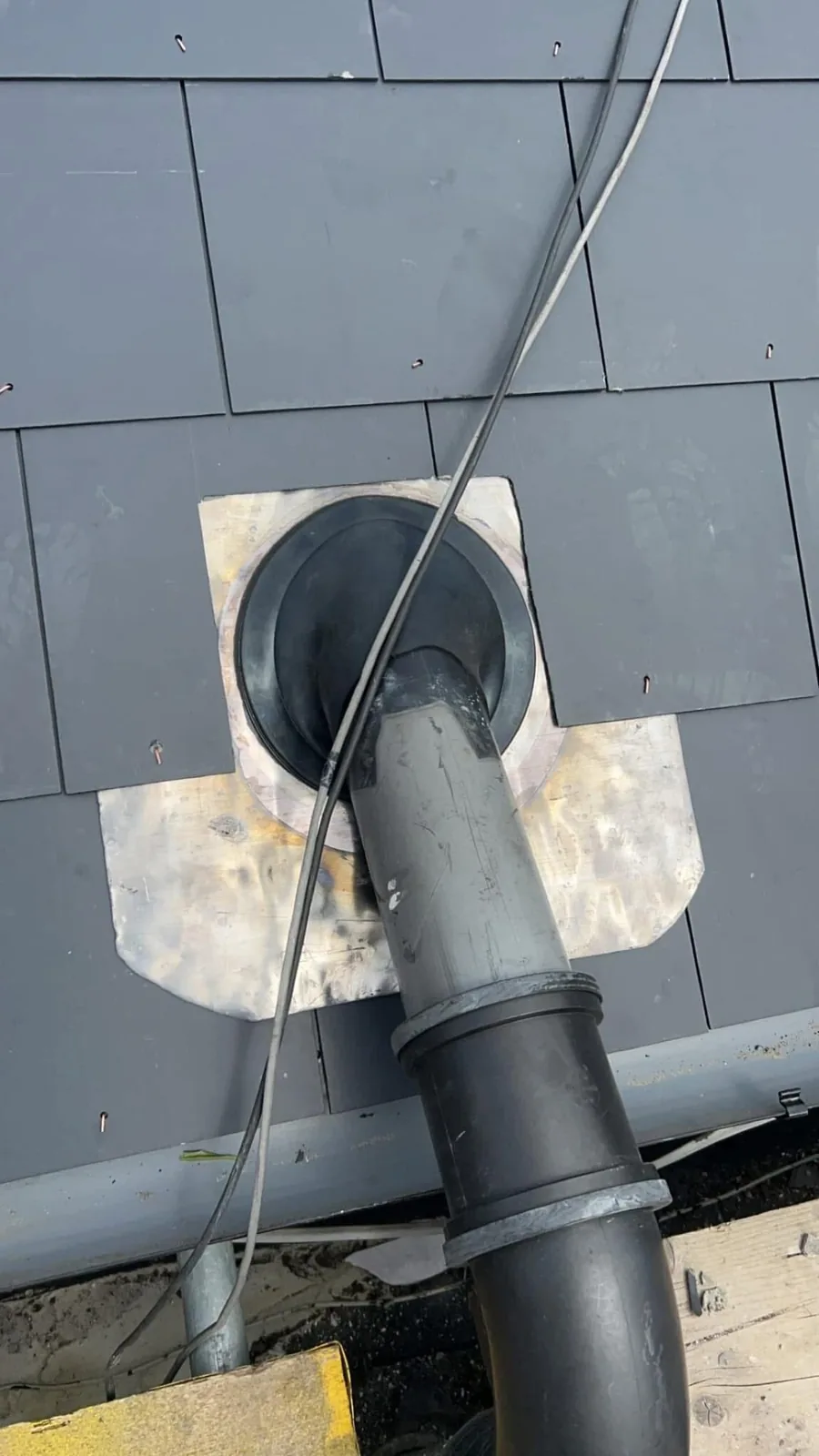
Dressing lead rather than bridging a gap
Lead can be shaped to follow changes of direction around masonry and roofing. Correct dressing creates a weathering path that sheds water while allowing the metal to respond to temperature. Fixing and joint details need to suit that movement. Unsupported sections, excessive lengths or inappropriate restraint can leave the material vulnerable to distortion or splitting.
Suitable joint sealants can form part of an appropriate detail, but they do not replace laps, support or properly shaped lead. A bead laid over a broad gap should not be mistaken for a complete repair. Removing an earlier patch may reveal whether the metal can be retained and re-dressed or whether a damaged section needs replacing.
Agree the repair boundaries
Before proceeding, ask which junctions are included and how much adjacent covering will need lifting. A front apron repair and renewal of an entire chimney weathering arrangement are not equivalent scopes. The condition of surrounding pieces can influence the work, so clarify the assumptions before comparing quotations.
A useful proposal separates the diagnosed defect from any uncertainty about hidden layers. If further inspection is needed, that should be explained. The photograph can help you describe the kind of junction involved, but cannot show what lies beneath the lead on your own property.
Recognising a problem and planning access
Look from a safe position for lifted edges, obvious splits or a flashing line that has separated from the masonry. Indoors, note when staining appears and whether it is close to a wall, chimney or valley. These observations help describe the problem but do not confirm its cause. Water can travel before it reaches a ceiling.
Do not climb onto the covering to press loose lead back into place. Access needs considering alongside the repair, especially where a glazed extension sits below. Contact us with the postcode and your observations. We provide free quotes during our Monday to Friday, 8am to 5pm working hours, without assuming a full replacement is needed for every junction leak.