
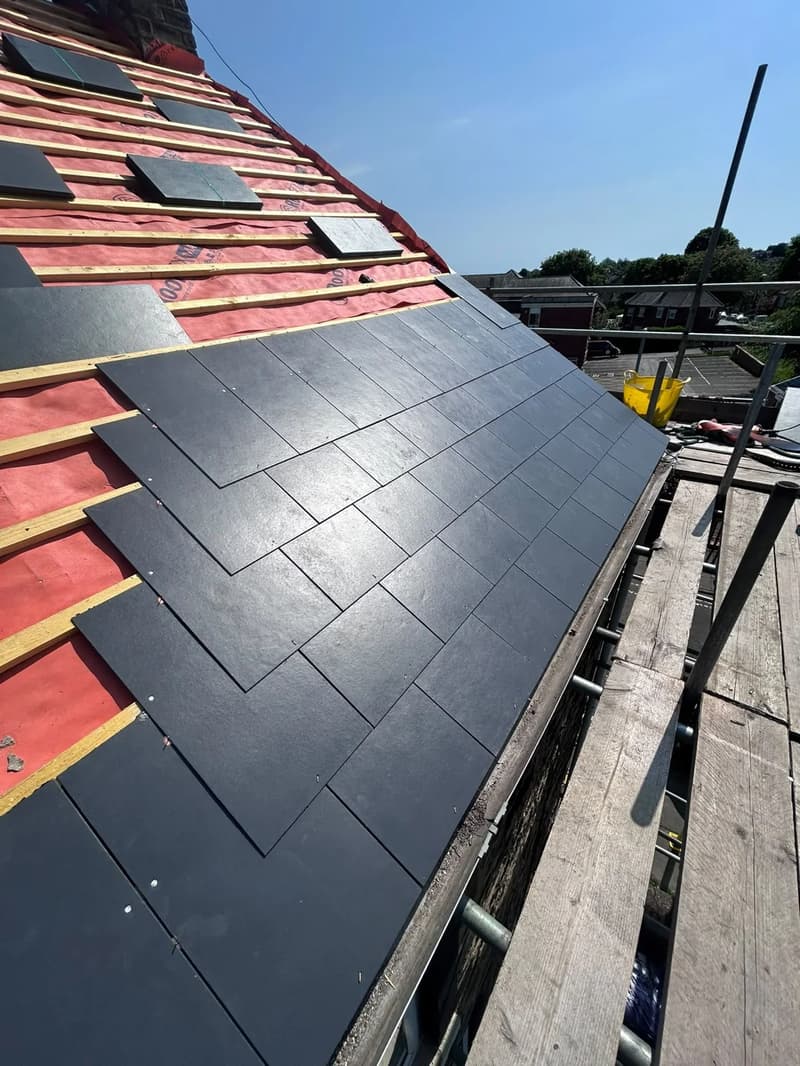
Roof work by McCluskey Roofing
How condensation forms in a loft
Warm air holds more moisture than cold air. When warm, damp air from the house reaches a cold surface, such as the underside of the felt or a nail head, it cools and drops its moisture as water.
In winter that water can freeze, then melt on a mild day and drip onto the insulation. The result can look exactly like a leak.
Condensation or a leak?
Condensation tends to be spread across a wide area, often on the north-facing slope, and is worst on cold, still mornings. A leak usually shows in one place, often below a chimney, valley or slipped tile, and is worst during or after wind-driven rain.
If you are unsure, check the loft on a dry, cold morning. If the felt is wet everywhere with no rain, condensation is the likely cause.
Blocked eaves
Most lofts rely on air entering at the eaves. When insulation is pushed right into the eaves, the air path is blocked. This is one of the most common causes, especially after extra insulation has been laid.
Fitting eaves trays or vents to restore airflow is often the first fix.
Non-breathable felt and roof sarking
Many older roofs have bitumen felt under the tiles or slates, sometimes called sarking. It keeps wind-driven rain out but does not let moisture escape. Combined with poor ventilation, that traps damp air in the loft.
Some roofs have no underlay at all, or boards. Each behaves differently, so it is worth having the roof checked before deciding what to do.
Bathroom fans and other sources
Extractor fans that vent into the loft instead of outside push warm, wet air straight into the roof space. Tumble dryer vents, unsealed loft hatches and gaps around downlights add to it. Ducting fans to the outside and sealing the hatch can make a big difference.
Reducing moisture in the house, by using extractor fans and opening windows after showers, also helps.
Wet loft insulation
Wet insulation does not work well and can stain ceilings. Once the cause is fixed, damp insulation may dry out, but heavily soaked or compressed material is often better replaced.
Fixing it properly
Most cases are fixed with better ventilation: eaves vents, tile vents or ridge vents, with the eaves kept clear. Our roof ventilation page explains those options. When a roof is due for replacement, a breathable membrane and built-in ventilation solve the problem at source. Our roof replacements page explains what a reroof involves.
Loft rooms and sloping ceilings
Where the loft has been converted, the roof structure is hidden behind plasterboard, so condensation shows as damp patches or mould on the sloping ceiling. Here, ventilation between the insulation and the roof covering matters. If that gap was not left during the conversion, fixing it usually means some work from outside.
Seasonal patterns
Condensation is usually worst from late autumn to early spring, when outside temperatures are low and windows are kept shut. You may notice it more after a cold, clear night, when the roof loses heat to the sky. In summer the same loft may look completely dry. That seasonal pattern is one of the best clues that you are dealing with condensation rather than a defect in the roof covering.
What to check yourself
From the loft hatch, use a torch to look along the underside of the roof at the eaves. If you cannot see any gap where air could come in, the eaves may be blocked. Check whether any extractor ducts end loose in the loft and whether the hatch closes snugly with a seal. Make a note of where the damp is worst, and whether the water is on the felt, the timbers or the insulation. That information helps us diagnose the cause much faster when we visit.
Need it sorted? Book a roof inspection
If you are not sure whether you are dealing with condensation or a leak, we can inspect the roof and loft and explain what we find. Ask for a free quote.
Photos and a short description of what you have noticed are always helpful.