
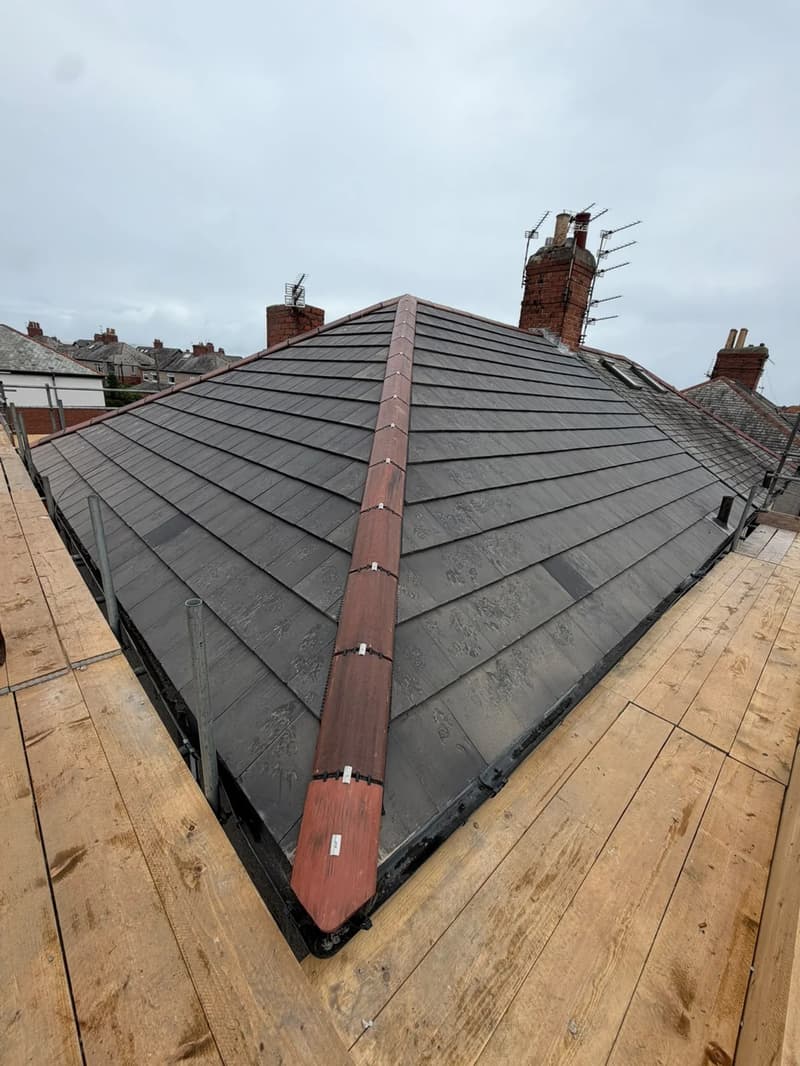
Roof work by McCluskey Roofing
Why tiles and slates slip
Every tile or slate on a pitched roof is held by nails, by nibs hooked over timber battens, or by a combination of both. When any part of that arrangement weakens, gravity and weather do the rest. On older slate roofs the nails themselves are often the problem. Iron nails corrode over the decades until the heads snap or the shanks rust through, and the slate simply slides out of place.
Battens can also fail. Timber that has been damp for years softens and splits, so nails pull out or nibs lose their grip. Wind is the obvious trigger, lifting the lower edge of a tile and loosening it a little more with every gust. Frost plays a part as well: water gets into small cracks, freezes, expands and gradually breaks pieces off the edge of a tile or slate until it no longer sits securely.
Why a single slipped tile matters
It is tempting to leave one out-of-line tile alone, especially if nothing is dripping indoors. The trouble is that each tile overlaps the ones below to form a continuous watertight layer. When one slides down, it leaves a gap that lets rain run straight onto the underlay or, on older roofs without underlay, directly onto the battens and rafters.
Older bitumen felt becomes brittle and tears, and water that gets past it soaks into timber and insulation long before a stain appears on a ceiling. A loose tile can also fall, which is a real hazard over paths, doorways and parked cars. Getting it refixed early is almost always quicker and less disruptive than dealing with the damp it causes later.
Tiles and slates are refixed differently
Interlocking concrete and clay tiles are generally simpler. Where the tile is undamaged, we lift the surrounding tiles, check the batten, and refit it with the correct fixing for that profile. Cracked or broken tiles are replaced, ideally with a matching tile from the same range or a sound reclaimed one of the same shape.
Natural slates take more care. Because each slate is nailed through near its head and covered by the course above, you cannot reach the original nail holes without disturbing neighbouring slates. The standard repair is to slide the slate back into position and secure it with a tingle, a strip of lead or copper fixed to the batten and folded up over the bottom edge, or with a purpose-made slate hook. Done tidily, the fixing is barely visible from the ground.
Matching matters on a slate roof. Slates vary in colour, thickness and size, so a replacement should come as close as possible to the ones already there, both for appearance and so it lies flat with the slates around it.
When repeated slipping means a bigger problem
If we refix a few slates and more follow within a season or two, the likely cause is nail sickness, where the original fixings have corroded across the whole roof rather than in one spot. Patching then becomes a running cost: each repair holds, but the slates beside it are just as close to letting go.
Other signs that the roof as a whole is near the end of its life include soft or sagging areas, daylight visible through the roof from the loft, widespread cracking and damp timbers. At that point stripping and recovering the roof, reusing sound slates where possible, is often better value than chasing individual failures. We will say plainly which way we think your roof is heading.
Ridge and verge tiles
The ridge along the top and the verges at the gable ends are the most exposed parts of the roof. Traditionally they are bedded in mortar, which cracks and washes out over time until ridge tiles rock in the wind or verge tiles come loose. These are not quite the same repair as a slipped tile in the middle of a slope, because the fix usually involves rebedding or fitting a dry, mechanically fixed system.
Booking a slipped tile repair
If you can see a slipped or missing tile, take a photo from the ground or a window and note where it is on the roof. Call McCluskey Roofing on 07770 714430, Monday to Friday between 8am and 5pm, or send the details through our contact page. Tiles lost after high winds may be part of wider storm damage, so tell us if several pieces came down at once.
We look at the area around the problem, not just the tile you can see, and then give you a free quote. If a loose tile is likely to fall, keep people away from the area below and we will discuss a safe assessment during our working hours.