
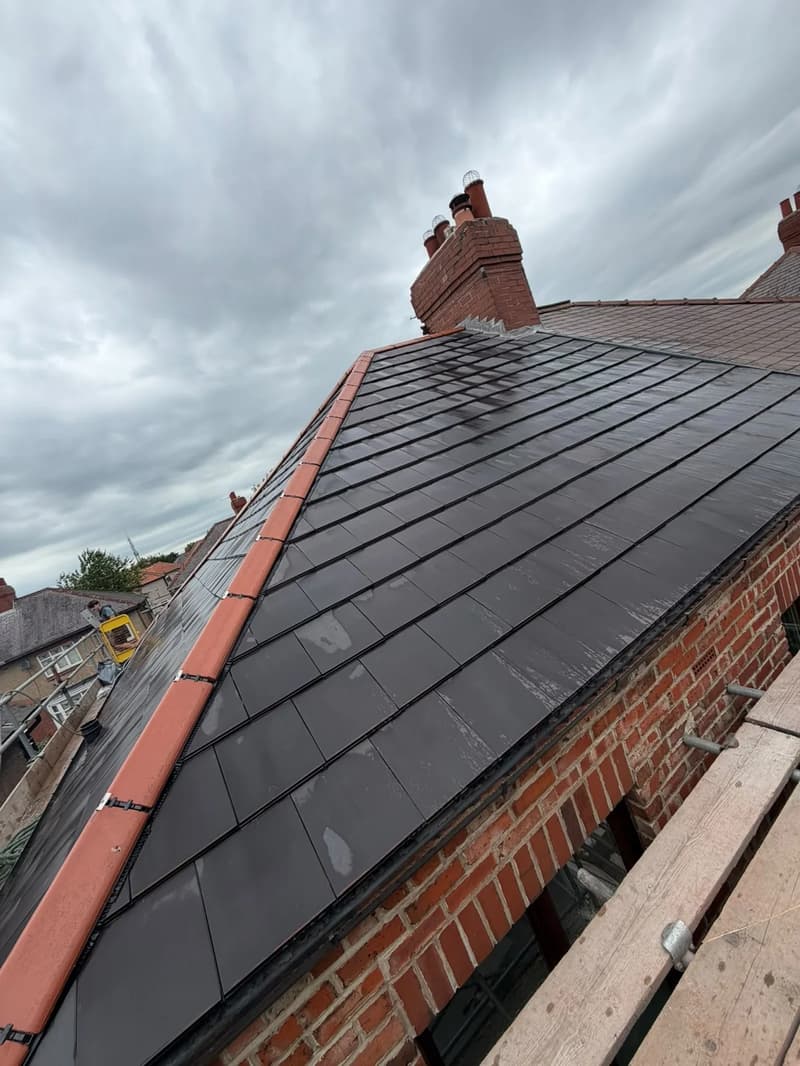
Roof work by McCluskey Roofing
Chimney leak, roof leak or condensation?
Start by noting when the wet patch appears. If it turns up during or shortly after heavy, wind-driven rain and dries out over a few dry days, water is almost certainly getting in from outside. If it appears on cold mornings, feels evenly damp across a wide area and sits on an outside wall or in an unheated bedroom, condensation is a strong possibility, especially where a fireplace has been blocked up without any ventilation.
Position helps too. Staining right against the chimney breast, often in a neat band where the stack passes through the ceiling, points towards the flashing or the stack itself. A patch a metre or two away may still be the chimney, because water can run along a rafter or the top of the ceiling before dripping, but it could equally be a slipped slate, a cracked tile or a worn valley further up the slope.
If you can safely get into the loft with a torch after rain, look at the timbers and brickwork around the stack. Wet brick inside the roof space usually means the water is coming through the chimney rather than around it. Please do not climb onto the roof to check; a description and a few photos taken from the ground or a window are plenty for us to go on.
Failed lead flashing and soakers
Where a chimney passes through a pitched roof, the gap between brick and covering is sealed with lead. On the sides there are usually stepped flashings tucked into the mortar joints, with soakers underneath each slate or tile. At the front there is an apron, and at the back a small gutter called a back gutter that catches water running down the slope above.
Lead lasts well when it is the right thickness and properly fixed, but it does not last forever. Joints where it is wedged into the brickwork can open as mortar crumbles, pieces lift in high winds, and older repairs done with mastic or flashing tape tend to crack and peel. A blocked or badly formed back gutter is a common culprit on the uphill side of the stack, because it holds water against the brick instead of shedding it.
Sometimes the existing lead can be dressed back down and repointed into the joints. Where it is split, thin or patched with sealant, renewing it is the more reliable fix. Our leadwork page explains the different details in more depth.
Crumbling mortar and porous brick
Chimneys take more weather than any other part of the house. They stand proud of the roof, catch rain from every side and go through frequent cycles of soaking, freezing and drying. Over time the mortar between the bricks softens and falls out, leaving open joints that let water soak deep into the stack.
Once it is inside the brickwork, water can travel down through the stack and appear lower in the house, well below the roofline. Old, soft bricks can also become porous, particularly on the side facing the prevailing weather. Raking out the failed mortar and repointing the stack closes those joints again and is often the main repair a leaking chimney needs.
Cracked flaunching and open pots
The flaunching is the sloped layer of mortar on top of the stack that holds the pots in place and throws rainwater off the top. When it cracks, which it often does after years of frost, water runs into the cracks and straight down into the brickwork below. Loose flaunching is also a safety concern, because it is what keeps the pots secure.
Open pots are a separate issue. A flue that is no longer used but still has an open pot will take in rain every time it pours. That water collects at the bottom of the flue or soaks into the chimney breast. Fitting a suitable cap or cowl keeps the rain out while still allowing some air to move through the flue, which helps the masonry dry out.
Damp patches on chimney breasts inside
Brown or yellow stains, flaking paint and blown plaster on a chimney breast are not always a roof leak. Old flues can carry salts from years of coal fires, and those salts draw moisture from the air and keep reappearing through new paint. Blocked-up fireplaces with no airflow make this worse.
The useful question is whether the damp gets noticeably worse after rain. If it does, there is probably a defect outside that needs fixing first. Once the stack is weathertight, internal plaster that has been soaked or stained by salts may still need attention from a plasterer, but there is little point redecorating until the water has been stopped at its source.
What a chimney repair visit involves
When you get in touch, tell us where the water appears, what the weather was doing and roughly how old the property is. We then arrange a time during our working hours, Monday to Friday 8am to 5pm, to look at the stack and the roof around it. We check the flashings, back gutter, pointing, flaunching and pots, and also the coverings nearby, so we do not repair the chimney while the real problem is a slipped slate a few courses up.
Access depends on the height of the stack, its position on the roof and what sits below. Some chimneys can be reached safely with roof ladders; taller stacks, or jobs involving rebuilding and full repointing, generally need scaffolding so the work can be done properly and safely. We explain which applies to your home before anything is booked.
You then receive a free quote setting out what we found and what we recommend. If water is coming in now, describe what is happening when you call so we can discuss a safe assessment during our working hours. You can reach McCluskey Roofing on 07770 714430, or send the details through our contact page.