
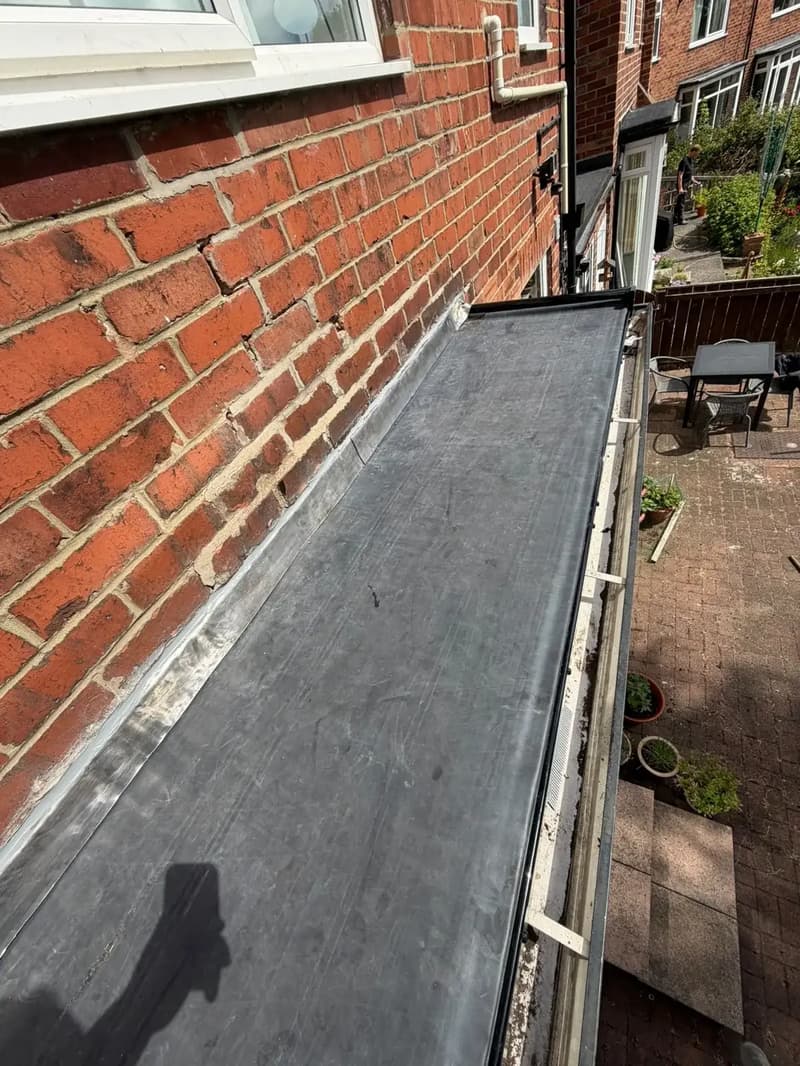
Roof work by McCluskey Roofing
Why extension roofs need careful detailing
An extension roof usually butts against the back wall of the house. Water running down the brickwork and off the main roof all lands at that junction, so the upstand there and the flashing above it have to be right.
The other edges finish with trims that guide water into the gutter, and any roof light or soil pipe passing through needs its own sealed detail. Small mistakes at any of these points can let water into the room below.
EPDM on extensions
We usually recommend an EPDM rubber covering for extensions. A single sheet means few or no joints in the field of the roof, and it stays flexible as timbers move. The membrane is bonded to the deck, turned up the wall at the upstand and finished under a lead or trim flashing.
Our EPDM page goes into the material itself in more detail.
Dormer flat roofs
A dormer roof is often small but high up, and it can be awkward to reach. The covering wraps over the front edge above the window, along the cheeks and back to the main slope, where it has to tuck under slates or tiles.
Dormer roof repair problems often come from that back junction or from old felt that has cracked at the front drip. Depending on what we find, a dormer may need a local repair or a full re-cover.
Edge trims, outlets and falls
A flat roof is never truly flat. It needs a gentle fall so water runs to a gutter or an outlet. If the old roof holds water, the deck may need firring pieces to improve the slope before re-covering.
Edge trims hold the membrane and shape the drip into the gutter. Outlets through a parapet or into a hopper need proper sealing, because a blocked or poorly fitted outlet quickly causes ponding.
Insulation and building regulations
When most of an existing flat roof is being renewed, building regulations in England can require the insulation to be brought up to a better standard where that is practical. A warm roof, with insulation above the deck, is a common way to do that.
We will explain what may apply to your roof, and building control or your council can confirm the position.
Roof lights and soil pipes
Kitchen extensions often have a roof lantern or flat roof light. Its upstand needs to be built properly and the membrane taken up and sealed under the frame, otherwise water finds its way in at the corners.
Soil vent pipes and extractor ducts need purpose-made pipe boots or collars. A neat seal at each penetration is as important as the main covering.
Dormer cheeks and fronts
The sides of a dormer, called the cheeks, are usually tiled, slated or clad. Where those meet the dormer roof, the edge detail has to overlap correctly so rain cannot track behind it.
The front edge above the window often has a drip trim that throws water clear of the frame. If that trim is missing or damaged, water can run back onto the window head.
Mixing materials
EPDM suits most extension and dormer roofs, but some prefer GRP for a balcony or a felt finish to match a neighbour. Our felt and GRP pages explain those alternatives.
Arranging a quote
Send us photos of the roof and the junctions if you can, and tell us about any leaks inside. We will look at access, the deck and the details, then give you a free quote.