
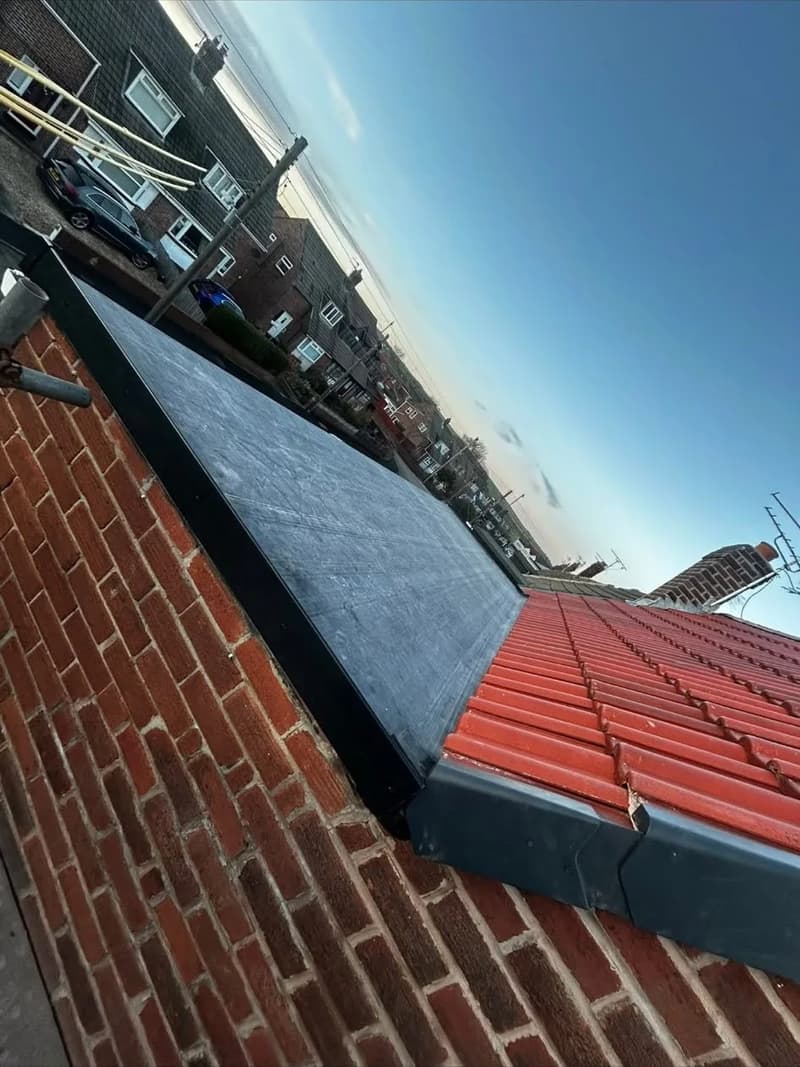
Roof work by McCluskey Roofing
What a cold flat roof is
Most older flat roofs on Tyneside extensions, offshoots and dormers were built cold. The joists carry timber boards, the covering goes on top, and any insulation is laid between the joists just above the ceiling. The deck and the timbers above the insulation stay at roughly outside temperature.
For that to work, the gap between the insulation and the deck has to be ventilated, usually through vents at the edges. Warm, moist air from the room below that slips past the insulation then has a way out before it can condense on the cold underside of the boards.
What a warm flat roof is
In a warm roof the insulation boards are laid over the deck, with a vapour control layer beneath them and the waterproof membrane on top. The timbers and the deck sit on the warm side of the insulation, close to room temperature.
Because the structure stays warm, there is no cold surface inside the roof for moisture to condense on, and no need to ventilate the void between the joists. That is why warm roofs are now the usual choice for new and renewed flat roofs.
Flat roofing
- Standing water and roof drainage considered
- Underlying deck condition assessed
- Upstands and wall junctions checked
Need advice about your roof?
Tell us what you’ve noticed. We’ll discuss the next step towards a free quote.
Request a free quoteCondensation risk compared
Cold roofs depend on ventilation that is often missing or blocked. Many older roofs have no vents at all, or insulation stuffed right up to the boards. Moisture then gathers on the underside of the deck, timbers rot and the problem can look exactly like a leak.
A warm roof deals with that risk by design, provided the vapour control layer is continuous and properly sealed at the edges. Gaps in that layer are where warm roofs go wrong, so the detailing matters.
Height and appearance
A warm roof adds the thickness of the insulation boards to the top of the roof. On an extension that can affect the edge trims, the upstands at the house wall, the step at a door threshold or the cills of windows above.
Those details are checked before work starts. Sometimes the fascia is raised or the trims adjusted. Where there is very little room, a thinner high-performance board or a hybrid approach may be considered.
Which suits your roof
For most extensions, garage roofs and dormers being fully re-covered, a warm roof is the sensible choice. It is easier to get right, protects the timbers and works well with EPDM membranes.
A cold roof may still be kept where the ceiling is being taken down anyway, where height is very tight, or where only a small repair is being made. In that case, good cross-ventilation and a vapour check at ceiling level are important.
Converting a cold roof to warm
Converting usually means stripping the old covering, checking the deck, laying a vapour control layer and insulation boards on top, then a new covering. The old insulation between the joists is often removed or reduced, and the old edge vents closed, so the roof does not end up half cold and half warm.
Done during a re-cover, most of the work happens from above, without disturbing ceilings inside.
Building regulations
Renewing most of a flat roof can bring in a requirement to improve its insulation where practical. A warm roof is a common way to meet that. Building control or your council can confirm what applies to your property.
Related pages
Our extension and dormer roofs page covers the detailing at walls and edges, and our EPDM page explains the membrane we usually use on top of a warm roof build-up.
Inverted roofs
A third option, the inverted roof, puts the insulation on top of the waterproof layer and holds it down with ballast or paving. It is more common on commercial buildings and roof terraces than on houses, because of the extra weight and height involved.
Summary
In short, a warm roof keeps the structure warm and dry, and a cold roof relies on airflow that is easy to lose.
Need it sorted? Book a flat roof survey
Tell us about the roof, the room below and any damp you have noticed. We will explain the warm and cold options for your roof and give you a free quote.