
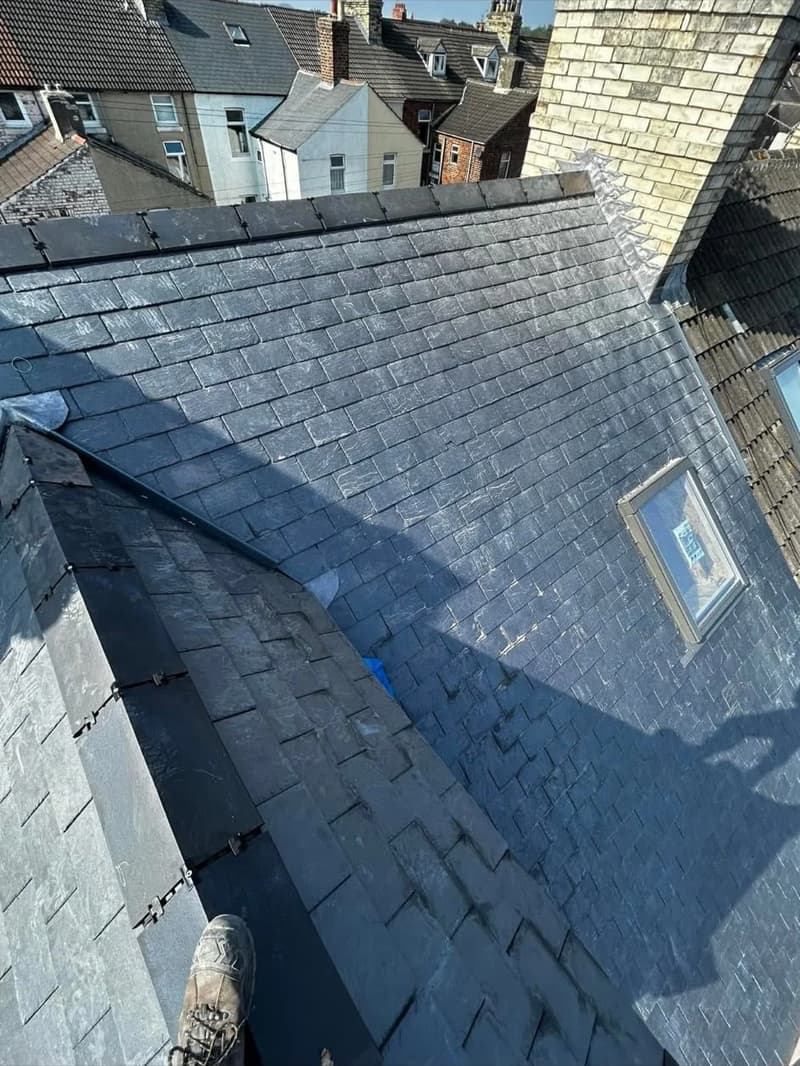
Roof work by McCluskey Roofing
Why slates slip and crack
Slate itself is very durable. What usually fails is the fixing. Older roofs were nailed with iron nails that rust through over time, a problem known as nail fatigue or nail sickness. Once the nail head goes, the slate slides down and either hangs out of line or drops into the gutter.
Cracks come from impact, people walking on the roof, frost working into a flaw, or a slate that was thin to begin with. Wind can also lift a slate whose fixing has weakened, snapping it at the nail holes.
How a slipped slate is refixed
Because each slate sits under the two above it, you cannot simply nail a replacement back in place. The usual method is a tingle: a strip of lead, copper or a purpose-made clip nailed to the batten in the gap between the slates beneath, with the new or refixed slate slid up into position and the tingle folded over its tail to hold it.
Stainless hooks are another option on some roofs. Either way, a good repair keeps the slate in line with its neighbours so water runs off as it should.
Matching slates on terraced roofs
Terraces often have Welsh slate, which has a distinctive blue-grey colour and wears very slowly. Where possible, sound reclaimed slates of the same size and thickness are used for repairs, so the patch blends in. A slate that is too thick or the wrong size lifts the ones around it and leaves a gap for rain.
When a repair stops being enough
A handful of slipped slates on a roof is a repair job. A roof where slates are coming down every few weeks, across several slopes, is telling you the nails have failed throughout. Tingling every slate is not a practical answer then, and stripping and re-slating, often reusing the good slate, is the more sensible route.
We explain what we see on your roof and whether a repair is likely to hold, so you can decide with the full picture.
Slate repairs on Tyneside terraces
Terraced streets bring their own considerations. Slopes are often steep, back lanes are narrow and the roof may run straight into the neighbour's on either side, with a shared chimney stack on the party wall. A repair near that boundary has to tie in neatly with the adjoining slates, and it helps to know whether your neighbour has had recent work done.
Rear offshoots are another common spot for problems. The small slate roofs over kitchens and back bedrooms are easy to overlook from the street, yet they often meet the main wall at a lead flashing that has worked loose. If you can see your back roof from an upstairs window, a quick photo is a useful starting point.
Other details checked during a slate repair
While on the roof, it makes sense to look at the ridge, any lead valleys, the flashings at chimneys and walls, and the condition of the slates around the repair. A leak blamed on a slipped slate sometimes turns out to come from a worn valley or a cracked ridge nearby.
What affects the cost
The number of slates involved, where they are on the roof and the access needed are the main factors. A slate near the eaves of a bungalow is a very different job from one high on a three-storey terrace. We price after seeing the roof.
When the work becomes a re-roof
If assessment shows that repair would leave widespread fixing or supporting-layer problems untouched, compare a complete slate replacement rather than simply adding more individual clips. That is a different scope, with decisions about retained stone, new battens and the adjoining roof.