
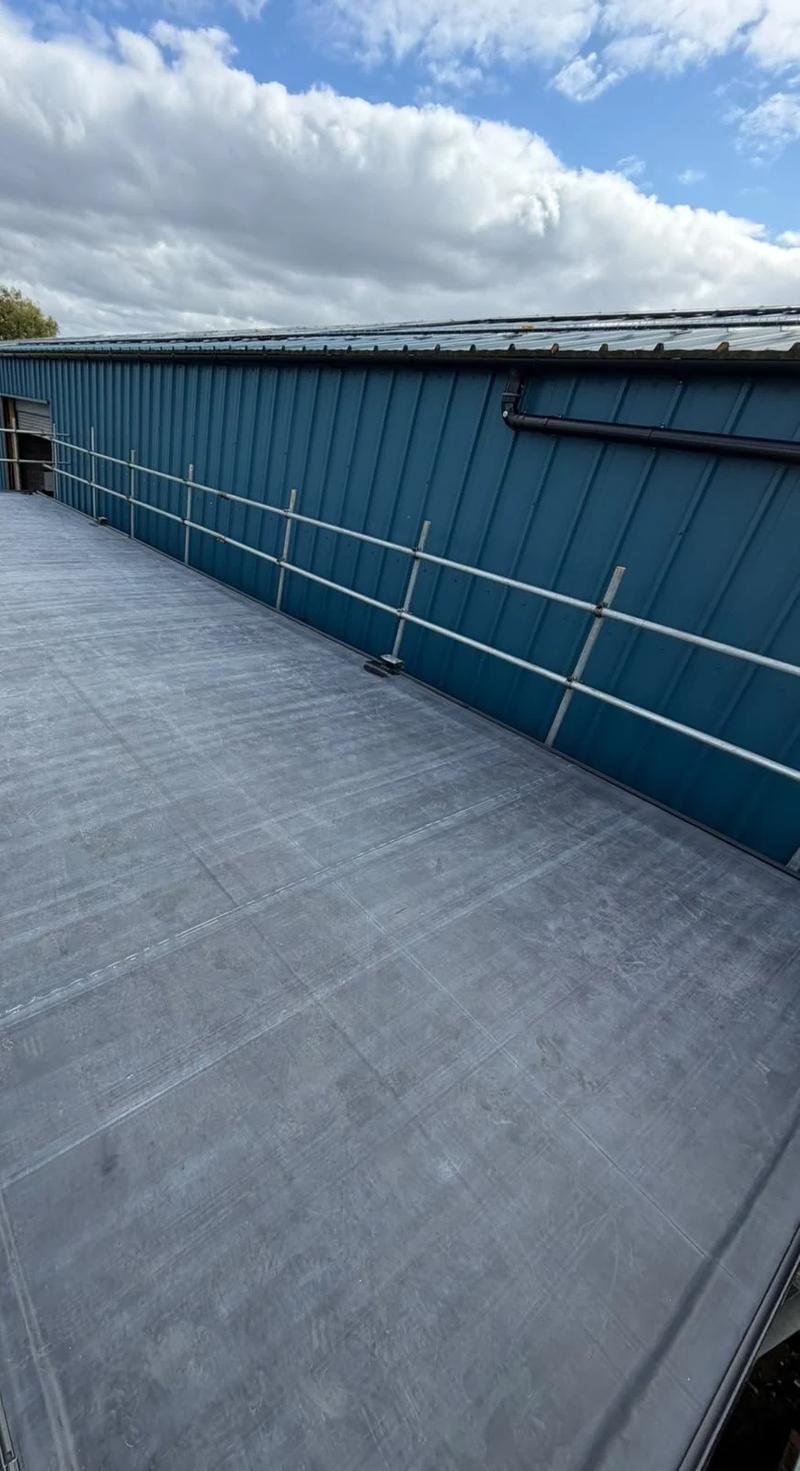
Roof work by McCluskey Roofing
How a felt roof is built
A traditional felt roof is two or three layers of reinforced bitumen sheet laid over timber boards. The top layer is often a mineral cap sheet, which has stone chippings bonded into its surface to protect it from sunlight.
Torch-on felt uses a gas torch to melt the bitumen on the underside of each sheet so it fuses to the layer below. Done well, the laps become a single welded skin. Done badly, they can open up along the edges.
Signs your felt roof is failing
Blisters are pockets of trapped air or moisture between layers. A few small ones may sit harmlessly for years, but large blisters crack in hot and cold weather and let water through.
Look also for splits along the laps, bare patches where the mineral surface has washed off, felt pulling away from the walls at the upstands and ponding that stays long after rain. Inside, a damp ceiling or a stale smell in the garage is often the first clue.
When felt roof repair makes sense
If the boards are firm and the damage is limited to one split, a lifted lap or a detail at a wall, a targeted repair can buy useful time. The area is cleaned, dried, cut back to sound felt and covered with a new patch bonded over the top.
Repairs to the edges and upstands are common because those are where movement and weather concentrate. Our flat roof repairs page covers leaks on other coverings too.
When roof felt replacement is the better call
Once the covering is cracked all over, soft underfoot or patched many times, another repair is mostly money spent on borrowed time. Soft spots usually mean the decking below is wet, and that has to be cut out before anything new goes on.
Replacement means stripping the felt, checking and renewing the deck where needed, and laying a new covering with fresh trims and outlets. At that point many people choose EPDM rather than another felt roof, while others prefer to stay with torch-on.
What affects felt roof cost
There is no single felt roof price because no two roofs need the same work. The size and shape of the area, the number of upstands, skylights or pipes, and how much rotten decking turns up once the old felt is off all change the total.
Access matters as well. A low garage roof at the front of a house is simpler than an offshot roof reached across a back yard. We explain each element so you can compare the options fairly.
Keeping a felt roof in good order
A little attention extends the life of a felt roof. Keep gutters and outlets clear so water drains away, brush off moss and leaves, and avoid walking on the surface, particularly in hot weather when the bitumen softens.
After a gale, look for lifted edges and laps. Catching a small fault early is far cheaper than dealing with a soaked deck later.
Torch-on felt and modern systems
Modern torch-on felt is a big improvement on the old pour-and-roll roofs. The sheets are thicker, reinforced with polyester and modified with polymers so they stay flexible in cold weather. A typical build has an underlay and a mineral cap sheet, both fully bonded.
Good detailing at the upstands and edges is what really makes the difference, which is why we take care over the trims and the flashings.
Felt or another covering?
If you are weighing felt against rubber, our comparison guide goes through how each behaves, how they age and which roofs suit each one. It is worth reading before deciding.
Whatever you choose, tell us what you have noticed and we will look at the roof and give you a free quote.