
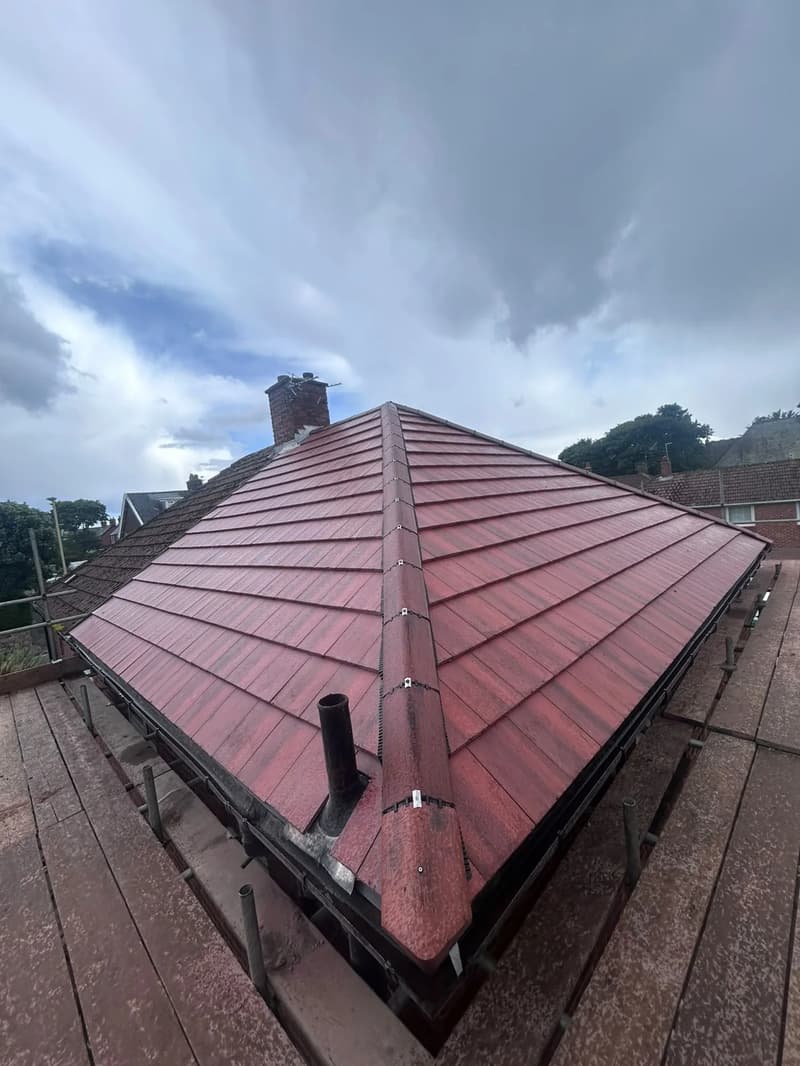
Roof work by McCluskey Roofing
What the underlay actually does
Tiles and slates shed most rainfall through their arrangement and overlaps. The underlay provides a secondary protective layer beneath them, helping manage wind-driven moisture that gets past the covering. Its detailing should provide a route towards the eaves rather than leave water trapped behind a fascia or above insulation. The material is therefore only part of the answer; the way it ends and meets other roof features matters too.
A membrane cannot make missing tiles, open flashing joints or inadequate roof pitch harmless. Nor should it be treated as an exposed permanent roof. During an assessment, the roofer needs to consider the condition of the covering and the hidden layers together. Seeing an intact sheet from inside the loft does not establish whether its laps, penetrations and outer edges are correctly arranged.
Breathable does not mean ventilation is irrelevant
Breathable underlays allow water vapour to pass through more readily than traditional high-resistance materials. That can influence moisture management within a roof, but the label alone does not establish the complete ventilation requirement. Some products are also air-permeable, which is a different property. Suitability depends on the particular material, the roof construction and the installation guidance that applies to that combination.
Warm indoor air can reach cold roof spaces through gaps around loft hatches, pipes and ceiling openings. The moisture it carries may condense on cold surfaces. A breathable membrane does not remove the need to think about air leakage, insulation continuity or ventilation paths. For an existing loft with damp timbers, investigate the moisture source before assuming that replacing the underlay will solve everything.
roof replacements
- Slate or tile options suited to the roof
- Supporting structure inspected after stripping
- Local defects compared with wider roof condition
Need advice about your roof?
Tell us what you’ve noticed. We’ll discuss the next step towards a free quote.
Request a free quoteNon-breathable felt under tiles
Older roofs may have bituminous felt beneath their coverings. A non-breathable underlay resists vapour passage, so the ventilation arrangement and separation from insulation deserve particular attention. Such a roof is not automatically defective just because it uses older material. What matters is whether the roof remains weather-resistant and whether the roof space manages moisture effectively in its actual construction.
Tears, sagging sections and brittle edges can appear differently inside the loft from the roof surface. Do not pull at old felt or try to patch inaccessible areas from a ladder. Small visible defects should be assessed in context, including whether they sit near an eaves detail or roof penetration. An inspection can establish whether local work is practical or a planned re-roof provides better access.
Choosing membrane during a re-roof
When the covering is stripped, the underlay can be considered alongside battens, fixings and the supporting structure. The selected material must suit the proposed covering, roof pitch and moisture strategy. Laps, support, nail penetrations and temporary exposure all have installation requirements. Ask for the proposed underlay specification rather than accepting the word membrane as a complete description of the roof build-up.
Insulation work can change that build-up, particularly when the roof space will become heated accommodation. The membrane, ventilation openings and thermal layers need coordinating before they are concealed. Roof replacement is an opportunity to resolve damaged underlay and poor junctions, not merely to swap one roll of material for another. Timing also depends on access and the sequence of stripping and rebuilding.
Questions to take into an assessment
Explain whether your concern is water staining, condensation, damaged felt or a planned replacement covering. Describe when moisture appears and whether work has recently been done in the loft. Photographs of accessible areas can be useful, but avoid entering unsafe spaces or disturbing anything uncertain. A roof-level inspection should be arranged with appropriate access rather than performed by the homeowner.
Ask how the chosen membrane connects to the eaves and how ventilation will be maintained. If insulation is being added, ask how the complete roof will deal with vapour and air leakage. Keep the underlay decision linked to the covering and supporting structure. That provides a much more useful basis for a replacement quote than choosing a material solely from a breathable label.
Need it sorted? Book roof replacements
For advice about roof membrane during a re-roof, tell McCluskey Roofing what covering is present and whether the concern is a leak, damaged felt or loft moisture. Include your postcode and describe any insulation changes being considered. We are based in Wallsend and cover Newcastle and the North East. Request a free quote for the relevant roof work, with the underlay and supporting details considered together.