
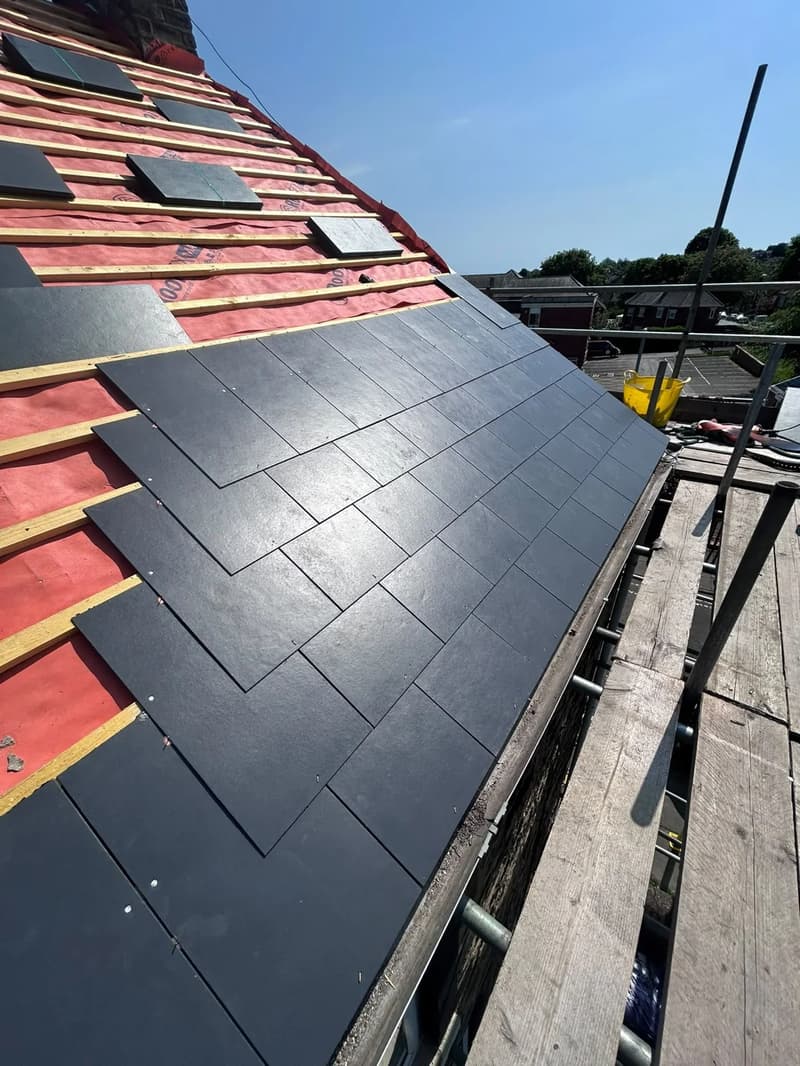
Roof work by McCluskey Roofing
Roof-level insulation and loft-floor insulation
Insulating at ceiling or loft-floor level normally leaves the roof void outside the heated part of the house. Insulating along the roof slope can instead bring the space beneath the rafters inside that boundary. These arrangements are not interchangeable: each needs a coherent approach to airflow, vapour control and the way the space is used.
A loft used only for storage may need a different solution from a room within the roof. Boarding, water tanks, cables and access to the eaves can affect what is practical. During a re-roof, there may be an opportunity to inspect areas that cannot be reached from inside, but the appropriate build-up still depends on the individual property.
Considering insulation during a pitched re-roof
When tiles or slates are lifted, the roof structure and supporting layers can be assessed before they are covered again. Insulation between or above rafters may be considered where appropriate. The available rafter depth, existing internal finish and external roof height all affect the design, so choosing a board thickness in isolation is not enough.
Roof junctions deserve attention alongside the main slope. Eaves, ridges, valleys and roof windows can interrupt the insulating layer or make ventilation routes difficult to maintain. A proposal should explain these details and how the new covering will fit. It should not assume that every existing roof can accommodate the same arrangement without alterations.
Insulation within a flat-roof build-up
On a warm flat roof, insulation generally sits above the deck with the necessary vapour-control and waterproofing layers. A cold roof places insulation below the deck and depends on suitable ventilation of the void. Mixing parts of both approaches without a design can create concealed condensation risks rather than improve the roof.
Adding insulation above the deck changes finished roof levels. That can affect wall upstands, thresholds, rooflights and edge trims. Drainage still needs to work after the build-up is altered. The warm-roof and cold-roof guide explains the principles in more detail; the final choice should reflect the construction and constraints found during assessment.
Keep ventilation and moisture control in balance
Warm air carrying moisture can enter roof spaces through ceiling gaps, service penetrations or poorly directed extract ducts. Insulation slows heat movement but does not, on its own, prevent this airflow. Depending on the build-up, a continuous air and vapour-control layer and appropriate roof ventilation may both be needed.
Do not pack insulation into an eaves opening simply because the gap feels draughty. That opening may be part of the roof ventilation route. Conversely, adding a vent does not correct a bathroom fan discharging into the loft. The source of moisture, the flow of air and the location of cold surfaces have to be considered together.
Details, regulations and the agreed scope
Roof renewal can bring requirements to improve thermal performance, depending on the work and circumstances. Building control can clarify what applies, including practical constraints. Structural loading, fire safety and ventilation requirements should not be overlooked while focusing on warmth. A suitable design is more important than a claim that one material works everywhere.
Ask which layers will be changed, what happens at the edges and whether interior work is necessary. If ceilings stay in place, the limits of inspection should be explained. Access, hidden damp and damaged timber can influence the scope, so an insulation discussion belongs alongside the roof assessment rather than after materials have already been ordered.
Start with the roof and the rooms beneath it
McCluskey Roofing takes roofing enquiries from Wallsend, Newcastle and the North East. Describe whether the roof is pitched or flat, which rooms sit below it and whether damp has appeared. Tell us if replacement work is already planned. That information helps frame a discussion about roof insulation without assuming an unseen construction is suitable for a particular method.