
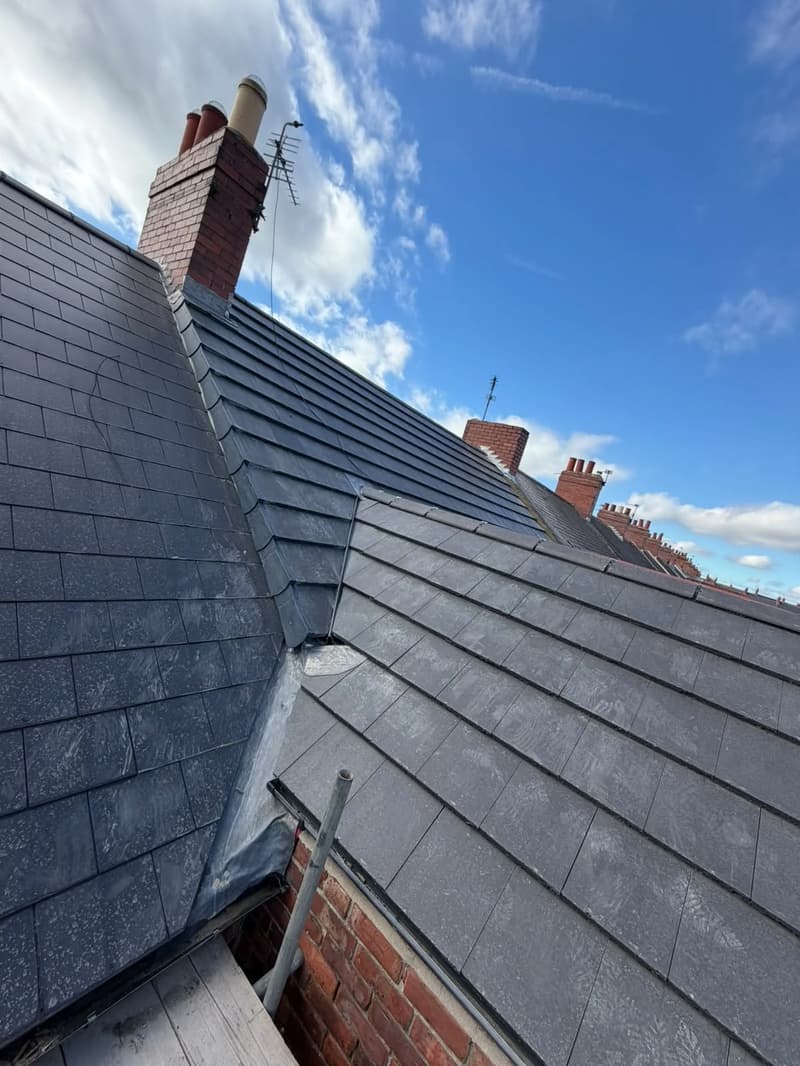
Roof work by McCluskey Roofing
How chimney flashing is made up
There are several parts. At the front, an apron flashing dresses over the slates or tiles below the stack. Down each side, step flashings are tucked into the mortar joints and lapped over soakers, small pieces of lead interleaved with each course of slates or tiles.
Behind the stack, a back gutter carries water around the chimney so it does not pool against it. Each part is cut and dressed by hand to fit that particular stack.
Signs chimney flashing has failed
From outside, look for lead lifting away from the brickwork, gaps where the mortar holding the step flashing has fallen out, or splits and holes in the metal. Inside, damp on the chimney breast or ceiling near the stack, especially after windy rain, is a common clue.
Some flashings have been covered with mastic or a painted coating as a quick fix. That can hold briefly, but it usually hides the original fault.
Chimney flashing repair or renewal
If only a short section has lifted or the joint has lost its mortar, the lead can be dressed back and the chase repointed. Where the lead is split, thin or badly fitted, renewing the whole set is often the longer-lasting answer.
Renewing chimney leadwork means lifting the slates or tiles beside the stack, fitting new soakers and step flashings, forming a new apron and back gutter and relaying the covering.
Lead or alternative materials
Lead is still the traditional choice because it can be dressed into almost any shape and lasts well when correctly sized and fixed. Some lead-free flashing products exist and can suit certain situations or tight budgets.
We will explain the options for your stack, including where lead is the more practical choice.
Other leadwork on the roof
Flashing at a chimney is one part of a wider family of leadwork that includes valleys, abutments and dormer cheeks. Our leadwork page explains those, and our chimney leaks page helps you track down where water is coming from.
Why flashing fails over time
Lead is a durable metal, but on older roofs it was sometimes laid in pieces that were too large, so it buckled and cracked as it expanded and contracted. Other common faults are flashing fixed with nails instead of being wedged into the joints, and mortar that has dropped out of the chase.
Wind-driven rain is especially hard on chimneys, so a stack on the windward side of the house tends to show problems first.
The back gutter
The back gutter sits on the uphill side of the stack and catches all the water flowing down the roof above it. If it is too shallow or has split, water spills over and runs into the roof. It is often the hidden cause of a chimney leak.
Combining flashing and stack repairs
Flashing is fixed into the brickwork joints, so if the stack is badly weathered the pointing may need doing first. Doing both while the access is up keeps the work efficient.
Checking from inside the loft
If you can get into the loft safely, look at the timbers and the brickwork where the stack passes through. Dark staining, damp mortar or wet insulation next to the chimney point towards a flashing fault rather than a problem elsewhere. Take a photo with the date so you can compare after the next downpour.
Next steps
Send us a note of what you have noticed and any photos. We will check the flashing and the rest of the stack and give you a free quote.