
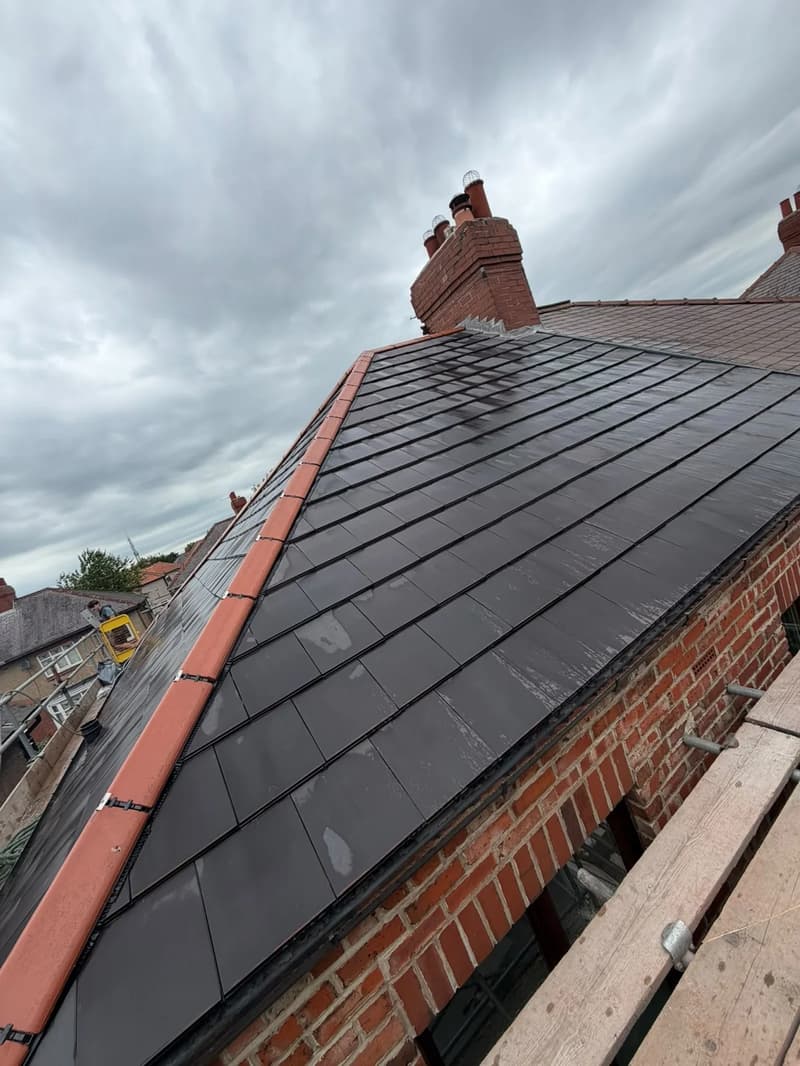
Roof work by McCluskey Roofing
What is flaunching?
At the top of a stack, the brickwork finishes with a flat course. The pots sit on that, and a bed of mortar is built up around them, sloping down to the outer edge of the bricks. That mortar is the flaunching.
It has two jobs. It holds the pots firmly so wind cannot rock them, and its slope sheds rain off the stack rather than letting it soak into the top of the brickwork.
Why flaunching cracks
The top of a chimney is one of the most exposed places on a house. Frost gets into small cracks and widens them, heat from flues expands and contracts the mortar, and older mixes simply weaken over time.
Once cracks open, water sits in them and the process speeds up. Eventually lumps break away, pots can loosen, and water starts finding its way into the stack below.
Signs to look for
Pieces of mortar in the gutter or on the ground, a pot that looks out of line, plant growth on top of the stack or damp on a chimney breast inside are all signs. Binoculars from the street or a photo from an upstairs window across the road can show a lot.
How flaunching is repaired
Safe access is set up first, usually scaffold or a suitable platform at the stack. The old, loose flaunching is broken out carefully, the pots are checked and the top of the brickwork is cleaned.
New mortar is then built up around the pots to a smooth slope with a clean edge. If the pots are cracked or no longer needed, this is the time to replace them or fit caps. Pots can often stay in place while the mortar around them is renewed.
Related chimney work
Flaunching problems often come with worn joints lower down the stack or failing flashing where it meets the roof. Our repointing page covers the brickwork, and our chimney leaks page helps if water is already coming inside.
Mortar mix and finish
Flaunching that lasts needs a well-graded mix, laid to a smooth slope with a firm edge at the top of the brickwork. A rough or flat top lets rain sit in it, and a mix that is too strong can shrink and crack.
Where the brickwork at the top is loose, a course or two may need resetting before new flaunching is laid. Bricks that move under the trowel are a sign the stack needs more than just new mortar.
Chimney pots and cowls
While access is in place, it is sensible to check the pots themselves. Cracked pots can be swapped for new ones. Cowls and bird guards can be fitted to pots that are in use, and caps or vented covers to those that are not.
We will talk through these options with you, as some flues serve working stoves or boilers and need the correct terminal.
Leaving the chimney sound
Once the flaunching is renewed, we look again at the pointing, the flashing and the pots so the whole stack is left in good order.
Stacks shared with neighbours
On terraces, a chimney stack is often shared with the house next door. Work on the flaunching affects both sides, so it helps to let your neighbour know before we start. Sometimes both owners choose to share the cost of access.
Getting it looked at
Tell us what you have noticed and, if you can, send a photo of the top of the stack. We will check the flaunching and the rest of the chimney and give you a free quote.