
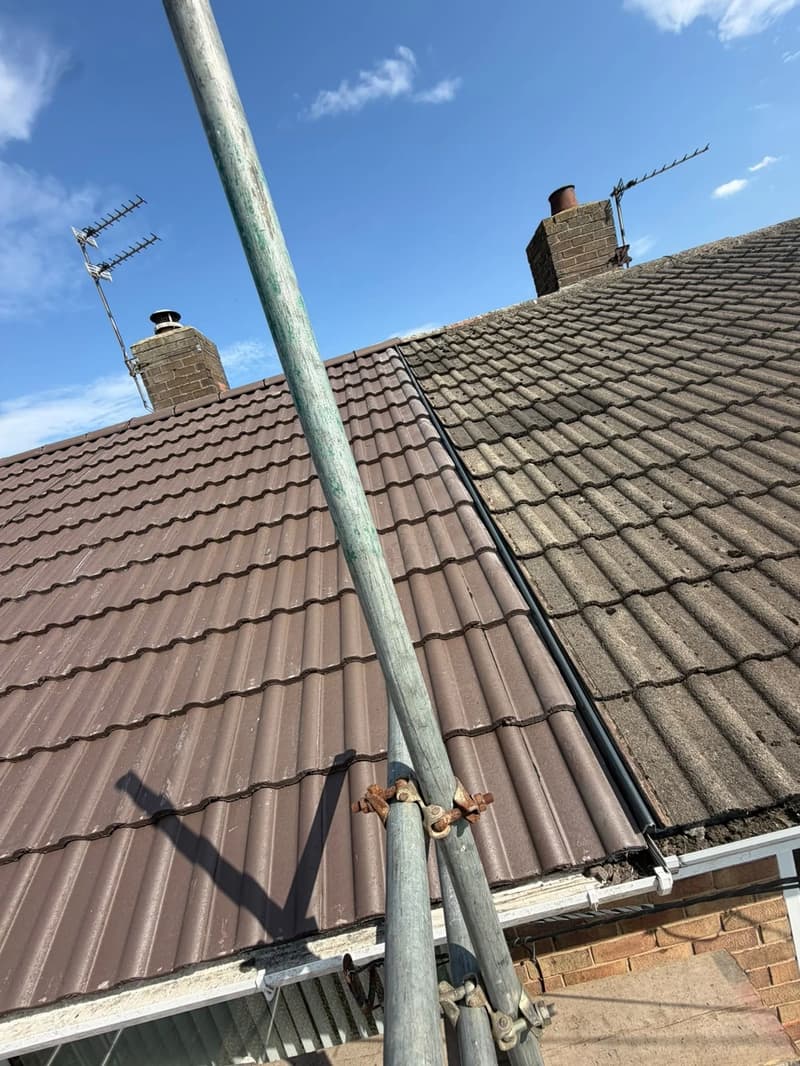
Roof work by McCluskey Roofing
Deciding whether moss needs removing
A light film of growth is different from deep clumps gathered between tiles. The useful questions are whether rainwater still drains freely, whether debris is reaching the gutters and whether the underlying covering is sound. Moss alone does not prove that a roof needs replacing, nor does a clean-looking surface prove that the roof is watertight.
Look from ground level for overflowing gutters, growth at roof junctions and material collecting around downpipes. Avoid climbing a ladder to scrape a test patch. Fragile coverings, uneven footing and the distance to the ground make roof cleaning a work-at-height task. An inspection can distinguish a maintenance issue from loose tiles or a drainage defect.
Careful hand removal rather than aggressive cleaning
Manual removal generally involves working with suitable tools to loosen growth without grinding away the face of the covering. The technique has to suit the material and its condition. Brittle tiles, delaminating slates and worn edges need particular caution; forceful scraping can turn a cosmetic concern into a leak or broken covering.
Debris should be collected and managed as the work progresses. Simply pushing moss into the gutter exchanges one problem for another. Access equipment, protection for neighbouring surfaces and the order of working all influence the practical method. An agreed cleaning scope should make clear whether gutter clearance and checks of outlets are included.
Why pressure washing deserves caution
High-pressure water can damage a tile surface, disturb pointing or force water beneath overlaps. An older covering may also be much less robust than it looks from below. Pressure washing is therefore not a universal answer for moss removal on a roof, and a method advertised for paving is not automatically suitable for roofing.
Any proposed washing or treatment should be checked against guidance for the actual covering, not just the equipment being used. Products also bring handling, runoff and plant-protection considerations. Ask what is proposed and why it is appropriate. A careful assessment may favour limited hand removal or leaving sound, lightly affected areas alone rather than pursuing a uniformly new appearance.
Clear gutters and check the route of rainwater
Roof debris can obstruct gutter outlets and build up around brackets or corners. Once growth has been loosened, the drainage route needs checking so rainfall reaches the downpipe rather than spilling down the wall. A blocked outlet and a leaking gutter joint need different remedies, even when both leave a damp patch underneath.
Gutter clearance will not repair a cracked fitting, a poorly supported run or an incorrect fall. These defects should be identified separately from the cleaning work. Our gutter repairs page explains joints, brackets and overflow, helping you describe what you have noticed before requesting an assessment.
Cleaning is not a substitute for repairs
Removing growth can reveal broken corners, displaced tiles or failing mortar that were previously obscured. Those findings should guide any repair discussion. Coating or cleaning over a loose covering does not put its fixings back in order, and repeated wetting cannot establish the condition of the membrane beneath it.
If there are slipped or missing tiles, deal with the defect rather than assuming moss is the main cause of a leak. Keep cleaning, local repairs and longer-term maintenance as separate decisions within the assessment. This makes it easier to understand what each part of the proposed work is intended to achieve.
Discuss a suitable roof cleaning approach
When you enquire, mention the covering, the extent of growth and any gutter overflow. Ground-level photographs can help show the affected slope without putting you at risk. Tell us about conservatories, narrow access or shared drainage below the roof, because protection and safe working arrangements matter as much as the cleaning technique.