
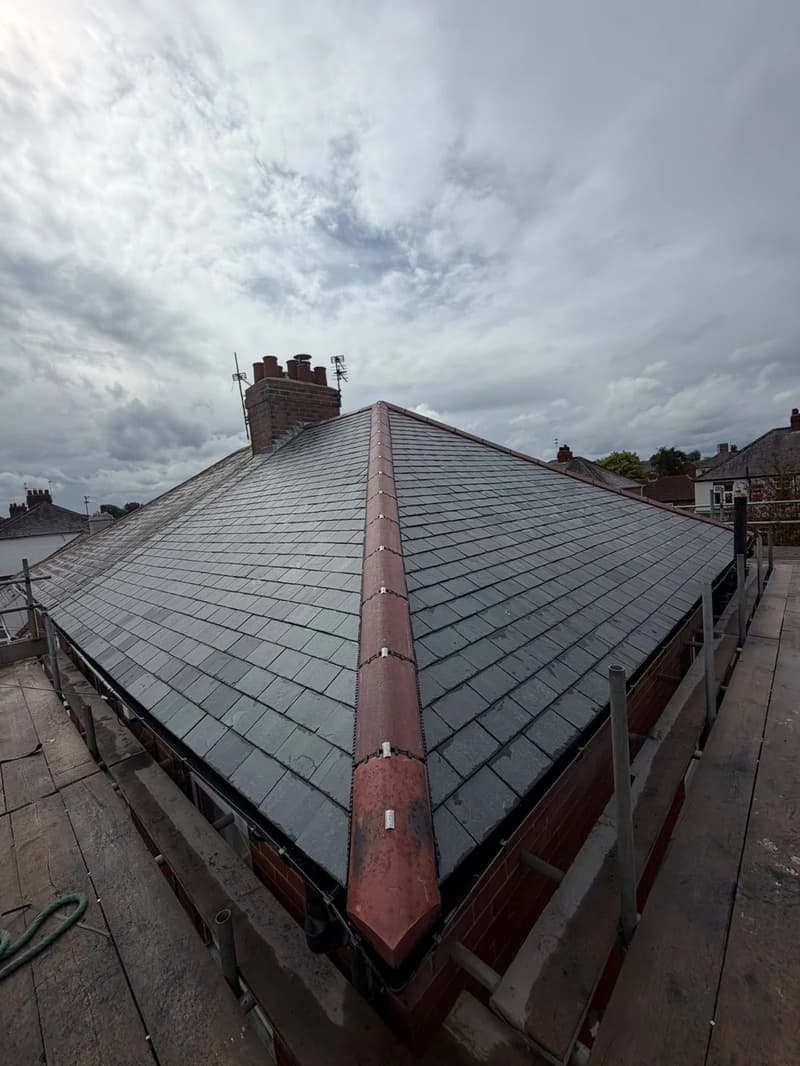
Roof work by McCluskey Roofing
Start with the question the inspection must answer
Explain whether you are concerned about water entry, visibly damaged tiles, a chimney or the overall condition of the covering. A focused roof inspection for a recurring leak is not necessarily the same as a broader assessment ahead of buying a house. The purpose influences which areas need examining and how the findings should be presented.
For a purchase, check what information your surveyor, lender or adviser actually requires. A roofing assessment should not be assumed to replace a building survey or structural engineer’s report. If a written report is needed, discuss its availability and scope before arranging attendance, rather than assuming every enquiry produces the same document.
Visible coverings and vulnerable junctions
An external assessment can consider displaced coverings, roof edges, ridge and verge details, flashing and visible chimney defects. Valleys and outlets deserve attention because they collect water from wider roof areas. A roof can have mostly sound tiles yet leak at one poorly formed junction, so a general appearance alone is not enough.
Observations must be tied to what can safely be seen. Ground-level views may reveal obvious displacement but not small splits or concealed fixings. Close inspection requires suitable access, and adjoining properties or extensions can limit the available positions. The findings should distinguish observed defects from areas that remain inaccessible or need further investigation.
Looking beneath the roof where access allows
Accessible loft areas can provide clues about damp, timber condition, ventilation and previous repairs. Water tracks sometimes help connect an internal mark to an external detail, although moisture can travel before appearing. Insulation, stored belongings and restricted headroom may hide parts of the structure, so the limits of a visual inspection should remain clear.
Opening up a roof is a separate decision from looking at accessible surfaces. An inspection without stripping cannot confirm every batten, fixing or hidden layer. Where symptoms suggest concealed damage, further checks may be recommended. This is a reason to define the scope, not a reason to promise certainty from an unobstructed view of the outside.
Turning findings into repair or replacement decisions
A useful assessment connects each defect to an appropriate next step. A local flashing problem may call for a targeted repair, while widespread deterioration can justify comparing replacement. The distinction depends on the supporting condition and the distribution of faults, not just the age someone estimates for the building.
Ask which work addresses the immediate symptom, which prevents related deterioration and which remains optional maintenance. If more than one approach is possible, their limitations should be explained. Our repair-or-replace guide gives a framework for that conversation without treating every small leak as evidence that the whole roof has reached the same point.
What affects roof survey cost and arrangements
Roof survey cost, roofing survey cost and roof inspection cost are all searches for the same practical uncertainty: what work is included in an assessment. Access equipment, roof complexity, the need for close examination and any requested reporting can change the scope. There is no reliable single price for an unseen property.
The site offers free roofing quotes, but a quotation for proposed work should not be confused with a specialist paid survey or formal report. Discuss the assessment you need and any charge before booking. Also identify who can grant access, whether the property is occupied and whether relevant purchase or previous repair information is available.
Arrange an inspection discussion
If you are searching for a roof survey near me, McCluskey Roofing is based in Wallsend and takes enquiries across Newcastle and the North East. Send the address, your main concern and the type of assessment you need. Describe the symptoms in your own words; there is no need to diagnose the fault before making contact.