
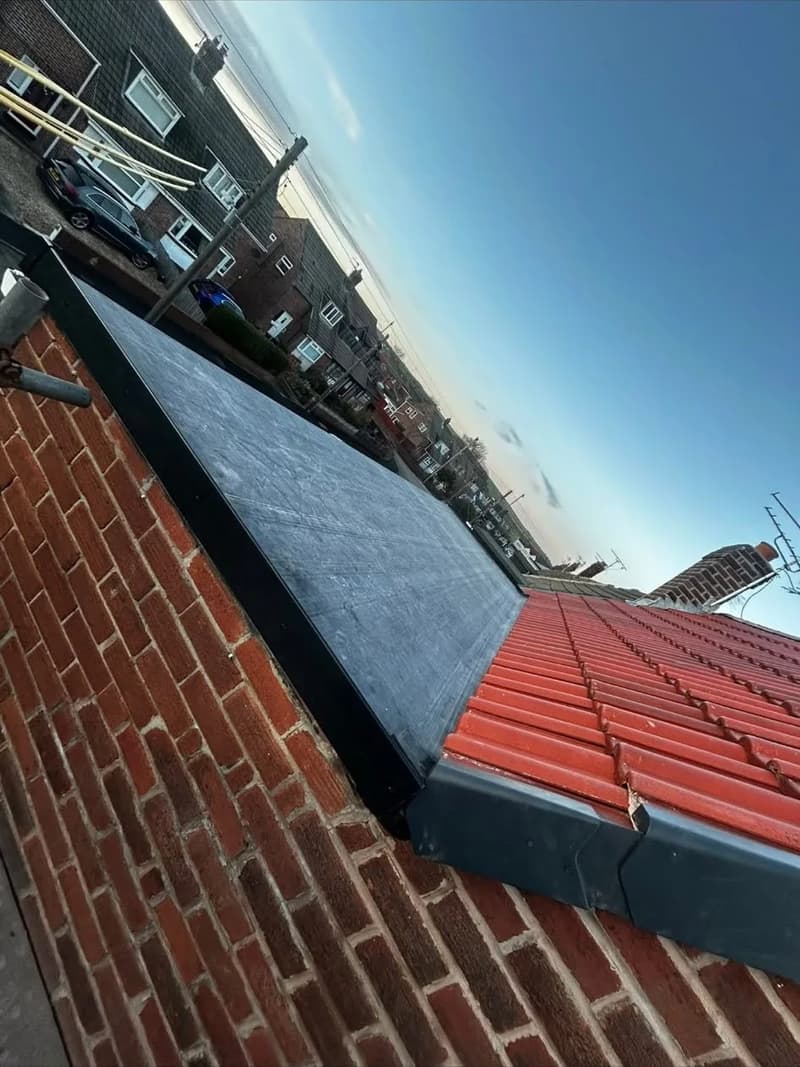
Roof work by McCluskey Roofing
What a liquid-applied system actually does
The coating cures to form a waterproof layer, often with reinforcement or separate treatment at vulnerable joints and details. Preparation, primers, coverage and curing conditions depend on the chosen system. A product intended for a small repair should not automatically be treated as a specification for renewing an entire roof.
The term liquid rubber can be used loosely in sales descriptions, so ask what material and build-up are proposed. Compatibility with the substrate and associated components matters. The work should be discussed as a complete waterproofing arrangement, not just a tin of coating with an appealing name or a claim that no preparation is necessary.
Where intricate detailing can favour liquid roofing
Roofs with multiple penetrations, awkward corners or closely spaced junctions can make sheet detailing more involved. A suitable liquid-applied system may offer a way to form continuous waterproofing around these shapes. Reinforcement, movement accommodation and termination at the edges still need the specified treatment; liquid application does not remove those requirements.
Upstands and outlets have to remain correctly formed and sufficiently clear of the finished roof surface. A coating that follows an existing puddle does not repair the roof fall. Where a junction has failed because its height or support is wrong, the underlying detail needs addressing rather than merely making it look uniformly coated.
An overlay needs a sound existing roof
An overlay retains much of the old construction beneath the new waterproofing. Before considering one, the existing covering must be checked for adhesion, compatibility and concealed moisture. Blistering, saturated insulation or a rotten deck can make covering over the surface inappropriate. The apparent saving in stripping work should not outweigh these defects.
Loose material and previous patches can interfere with bonding, while damp trapped beneath a coating may remain concealed. Investigation may be needed to establish what is happening below the visible surface. If a local repair is suitable, its scope should remain clear; if the construction is failing more widely, renewal may be a better comparison than another overlay.
Compare with EPDM and GRP rather than assuming equivalence
EPDM uses a rubber membrane sheet with compatible junction and edge details. GRP uses a resin and reinforcement arrangement over an appropriate prepared deck. Liquid-applied systems have their own specifications and may be chosen for different constraints. They should be compared against the roof’s shape, access and supporting condition, not treated as interchangeable finishes.
On a straightforward suitable flat roof, a sheet membrane may provide a different installation route from a liquid system. On complex details, liquid application may be considered where its specification supports that use. The comparison should also consider future inspection and repair access, drainage and the treatment of roof-level insulation.
Application conditions and the agreed specification
Temperature, surface moisture and weather affect preparation and curing. The proposed method must follow the system’s guidance, including any primer and reinforcement requirements. Areas where rainwater collects or foot traffic occurs may need particular consideration. Applying more coats at random is not a reliable substitute for the specified coverage and build-up.
Clarify which existing layers will remain, how defects will be repaired and what happens at edges, outlets and wall junctions. A roofing quote should identify the planned scope so the coating is not assumed to fix every underlying problem. Work above occupied rooms also needs protection and a suitable sequence while waterproofing is being changed.
Discuss suitability for your flat roof
Describe the current covering, the roof shape and whether leaks return around a particular outlet or junction. McCluskey Roofing takes flat roofing enquiries from Wallsend across Newcastle and the North East. An assessment can help compare the available approaches without claiming that a liquid system will suit every roof or that coating alone will repair a deteriorated deck.