
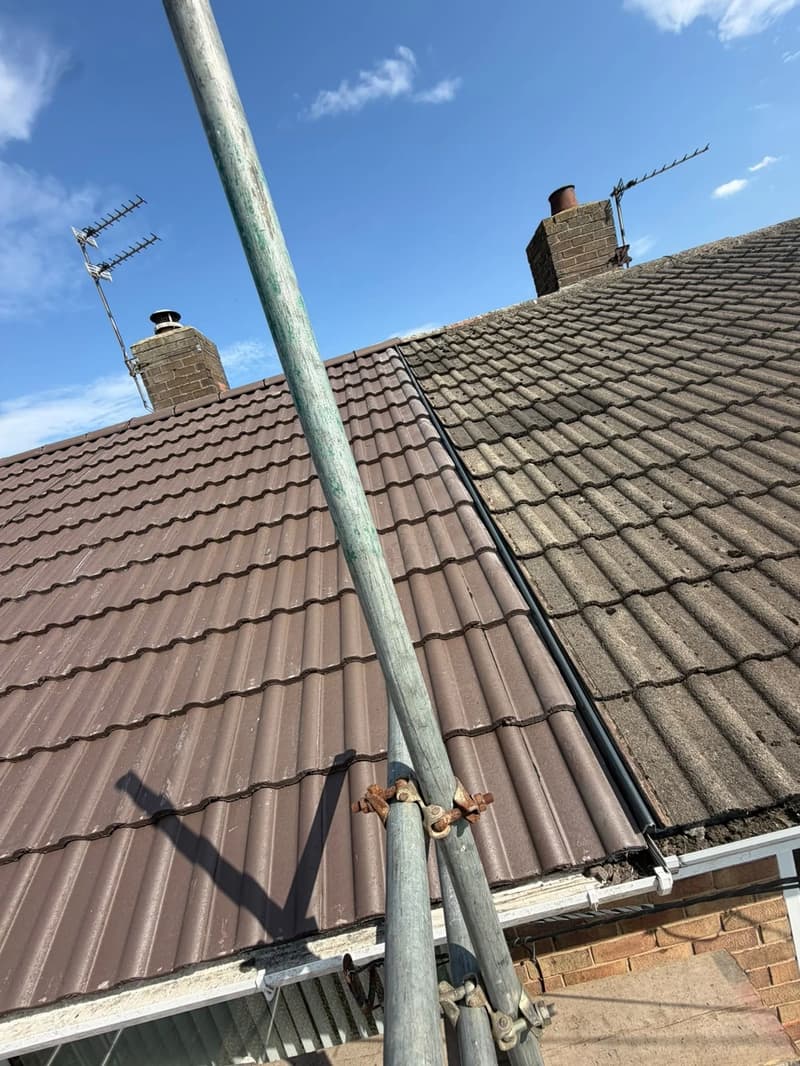
Roof work by McCluskey Roofing
Period roofs and visible symptoms
On a city-centre period home, a leak may involve a valley, chimney junction or ageing slate fixing rather than the most obvious damaged piece. Water can move across underlay or follow a timber before reaching the ceiling. The stain's location therefore narrows the investigation but does not identify the entry point by itself.
Note whether the mark grows during sustained rainfall, appears after gusts or stays damp between wet spells. A blocked drainage detail and an internal moisture problem can produce different patterns. Photographs inside an accessible room are useful, but avoid entering a loft with uncertain flooring or reaching out of windows to inspect the covering. Safe roof-level access is part of a proper assessment.
Stone terraces and joined roof slopes
Stone terraces can bring uneven roof lines, shared masonry and alterations made at different times. A repair needs to respect the surrounding material and the way adjoining slopes shed water. Stone walls do not establish what mortar or flashing arrangement is suitable; those details must be considered for the actual building.
In former colliery villages around Durham, terraced homes may combine original roof shapes with replacement tiles, rear additions and newer roof windows. Do not assume a roof remains in its original form simply because the street has a consistent appearance. Tell us if an adjoining house has been re-roofed or your property has had an extension. Such changes can influence where water is concentrated.
Repairing slate, tile and roof junctions
An isolated slipped slate or cracked tile may be replaceable when the surrounding covering and support are suitable. If several pieces have moved, their fixings and the underlying condition deserve a wider check. The repair should explain both the immediate replacement and why it is expected to address the observed defect.
At ridges and verges, loose bedding or displaced components require their own assessment. At a chimney or wall, failed leadwork can let rain behind an otherwise sound covering. These are not interchangeable repairs: renewing mortar cannot close a split in lead, and a new tile cannot correct an open wall junction. Ask which detail is implicated and what evidence supports that conclusion.
Flat roofing Durham: separate construction, related leaks
A flat extension may sit below a pitched roof, receiving runoff or meeting a wall beneath the main eaves. A leak there can involve its surface, upstand, outlet or supporting deck. Persistent ponding should prompt a look at drainage and shape rather than an automatic recommendation to cover the existing material again.
The use of the room below matters too. A heated extension needs the insulation and moisture arrangement considered with any significant roof work. Local repairs may be possible on a suitable covering, while widespread deterioration or softened support calls for a broader proposal. Our flat roofing page explains these elements without assuming all Durham extensions need the same membrane or replacement build-up.
Restrictions, access and a clear repair brief
For a listed property or a home in a conservation area, check relevant requirements before changing roof materials or visible details. A repair enquiry should mention any known designation along with narrow streets, shared yards or difficult access. These factors help plan the work without making promises about permissions.
Request a free quote with your Durham postcode and a concise history of the fault. If previous work has not resolved it, explain what was done and how the leak behaved afterwards. We can discuss repair scope and whether further inspection is needed. Use the Durham hub for broader services, or the replacement page if the existing roof has widespread defects rather than one local problem.